

AI adoption is on the rise in India, with 61% of desk workers incorporating AI into their roles and 94% feeling a strong urgency to master it, according to Slack's Workforce Index. Additionally, 80% of Indian workers are excited about AI’s potential to replace some tasks, solidifying India’s position as a global leader in AI adoption. However, despite this enthusiasm, there remains uncertainty and discomfort surrounding its use. A significant 21% of Indian workers are hesitant to disclose their use of AI to managers, fearing they may be perceived as incompetent or lazy.
According to McKinsey, AI could increase corporate profits by $4.4 trillion annually, and Salesforce research reveals that sales teams using AI are 1.3 times more likely to see revenue growth. To fully realise AI’s potential, employers must encourage its use by providing clear guidance and training.
“India’s workforce is leading the way in AI adoption, and this enthusiasm aligns with leadership priorities for innovation and upskilling. However, to fully harness AI’s benefits, there remains uncertainty that agents can address. By introducing AI agents with clearly defined roles and guidelines, businesses can reduce worker anxiety and foster seamless integration into daily tasks,” said Rahul Sharma, Vice President - Sales, Salesforce India.
Why Do Some Workers Hide Their Use of AI?
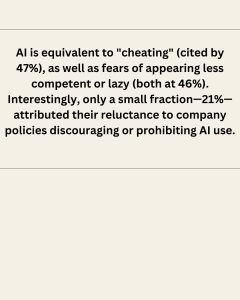
Many Indian employees are still reluctant to openly acknowledge their use of AI in the workplace, despite growing enthusiasm around the technology. A significant portion, about 21% of Indian desk workers, said they feel uncomfortable admitting to their managers that they used AI for common workplace tasks. This hesitation stems from fears about job security, concerns over being perceived as less capable, or worries about being seen as lazy.

The uncertainty surrounding company policies on AI usage further complicates matters. While some workers remain unclear about the boundaries of permissible AI use, the hesitation isn't merely about official guidelines. Instead, it often revolves around deeper questions of social and professional acceptability. For instance, nearly half (48%) of desk workers admitted they would feel uneasy telling their managers they had used AI for tasks such as drafting messages, brainstorming ideas, data analysis, or coding.
Conversely, those who are comfortable being transparent about their AI usage are significantly more likely to integrate it into their work. This highlights a critical gap: while AI can boost productivity and efficiency, workplace culture and social dynamics may hinder its adoption.
As Christina Janzer, head of the Slack Workforce Lab, points out, “Our research shows that even if AI helped you complete a task more quickly and efficiently, plenty of people wouldn’t want their bosses to know they used it. Leaders need to understand that this technology doesn’t just exist in a business context of ‘Can I get the job done as quickly and effectively as possible,’ but in a social context of ‘What will people think if they know I used this tool for help?’”
How Can Leaders Effectively Integrate AI into the Workplace?
With employees holding diverse opinions on the acceptability of AI use at work, leaders must take tailored approaches to foster AI adoption. Even within the same team, attitudes toward using AI for specific tasks can vary widely, making it essential to address these differences thoughtfully.
Team-Building with AI Personas
Just as personality or strengths assessments are used for team building, leaders can organize exercises to explore perspectives on AI. Past Workforce Lab research has identified five AI personas that reflect common attitudes toward the technology. By conducting these exercises, teams can better understand individual viewpoints, clarify expectations, identify barriers to adoption, and uncover creative applications of AI across roles and functions.
Showcasing AI in Action
Promoting visibility around AI use can help establish workplace norms. Encourage employees to share how they’re using AI tools, either in a dedicated Slack channel or during team meetings, where they can also troubleshoot challenges and discuss the latest AI trends. Leaders can set an example by openly sharing their own AI experiences—both successes and lessons learned—to demonstrate that experimentation is encouraged and valued.
Workers Expect AI-Savvy Employers
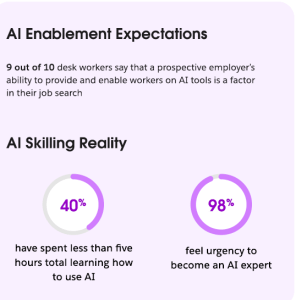
Indian workers are eager to upskill in AI, with 94% expressing urgency to become AI experts. However, 40% of Indian workers have spent less than five hours learning AI tools, and 30% of global workers report no AI training at all, including self-directed learning or experimentation. This highlights a significant gap that employers must address by offering training, clear guidelines, and supportive environments.

Nearly 2 in 5 workers globally prefer companies that provide AI tools and enable their use, making AI enablement a critical factor in talent retention. In India, 98% of workers consider AI training a key factor in job searches. Workers with AI guidance have seen a 13% rise in adoption since January, compared to just 2% among those without guidance. First-time job seekers are 1.8 times more likely to prioritize AI enablement, underscoring its growing significance in the workplace.
“This finding shows that companies that drag their feet on AI enablement are compromising their ability to attract and retain top talent,” says Nathalie Scardino, president and chief people officer at Salesforce. “As AI and agents become an integral part of the workplace, employees will increasingly gravitate toward organisations that prioritise innovation and provide the tools necessary to stay competitive.”
The survey encompassed 17,372 workers across 15 countries, including Australia, Brazil, Canada, France, Germany, Italy, Japan, the Netherlands, Singapore, Spain, Sweden, Switzerland, the UK, the US, and India. Of these, 1,029 participants were desk workers from India.
How can leaders ensure AI saves time without increasing workload?
While much of the excitement around AI centers on its potential to save workers time, a disconnect exists between the ideal and actual outcomes. According to the data, workers desire AI to help them refocus on meaningful activities, such as non-work pursuits and learning. However, when asked how they would spend the time saved, many said they would redirect it towards more administrative tasks and existing core projects. The perception that AI could lead to an increased workload is prevalent, with 87% of respondents believing AI is best suited for administrative tasks. As Janzer points out, employees worry that the time saved may just result in faster work at a higher pace, rather than improving work quality. This presents an opportunity for leaders to redefine productivity by encouraging employees to focus on quality rather than simply quantity.
Leaders can focus on two key areas to optimise AI's potential: upskilling and redefining productivity. Employees are eager to learn, with 76% feeling an urgency to become AI experts, driven by industry trends and personal growth. This presents an opportunity for leaders to prioritise learning and skill-building, aligning with workers' desire to focus on meaningful activities.
Moreover, while AI's potential to enhance productivity is widely acknowledged, leaders should shift the narrative from just increasing output to encouraging innovation. Executives prioritise “innovative or creative work projects” over “administrative tasks,” suggesting that leaders should redefine productivity to foster creativity and business growth, rather than just amplifying routine work.
India's focus aligns closely with leadership goals: Indian workers are leveraging AI to align with leadership priorities more effectively than their global counterparts. While global executives want employees to focus on upskilling and innovation with the time saved by AI, Indian workers are already embracing these priorities. The top activities Indian employees expect to prioritise with AI-enabled time savings include:
- Learning and skill-building
- Innovative or creative work projects
- Advancing work on core projects
How Can Leaders Address the Risk of AI Eroding Social Connections in the Workplace?
Data indicates that AI users are increasingly turning to AI for advice rather than consulting friends or colleagues—81% of AI users rely on AI for help with important projects at least occasionally, with 28% doing so frequently. This trend is most prominent among Gen Z and Millennial workers, who are more likely to turn to AI in place of a peer—30% of Gen Z and 33% of Millennials report using AI frequently, compared to 23% of Gen X and just 13% of Boomers.
For leaders, this shift presents a challenge. Mick Costigan, VP of Salesforce Futures, suggests that AI should not only be viewed as a tool for efficiency but also as a catalyst for redefining human collaboration. “As AI and agents scale across workflows and industries, more is at stake for each human-human interaction, and leaders will need to approach human connection with greater intentionality.
Mamta Sharma is a freelance journalist committed to sharing stories on talent management, DEIB, workplace culture alongside narratives on leadership, entrepreneurship, tech innovation and employee wellbeing.