

Some engineers build bridges, some build algorithms, and a few quietly begin building futures—both theirs and the organisations they work for. They start with code, systems, and processes. Then one day, they look up and realise the role they signed up for no longer fits their ambitions.
This Engineers’ Day, we are not just celebrating those who execute technical brilliance. We are celebrating those who outgrow engineering itself; the curious minds who move into product strategy, design thinking, and even entrepreneurship. The question organisations face is simple yet critical: how do you retain these engineers within the ecosystem, rather than losing them to external opportunities?
To explore this, we spoke with four leaders who encounter this evolution every day: Navaneet Mishra, SVP and Head, Hexagon R&D India; Prashanth Nanjundappa, VP of Product Development, Progress Software; Sandeep Gupta, Executive Director, JP Morgan, GARP FRM certified professional; and Yadhu Kishore Nandikolla, Human Resource Senior Director, Evernorth Health Services India.
Their insights reveal not only how organisations can engage engineers who transition beyond technical roles but also why redefining premium talent is essential.

Retaining Engineers Who Transition Beyond the Technical
Engineers, by training, are skilled problem solvers. Over time, many yearn to apply their skills to areas like strategy, design, and entrepreneurship. If organisations fail to offer these opportunities internally, attrition becomes inevitable.
Navaneet puts it simply: “Retaining talent isn’t just about keeping people; it is about helping them grow holistically and take on new challenges. Organisations will, in fact, grow faster when engineers expand into strategy, design, and new domains. By identifying those who show curiosity and cross-learning potential, and giving them exposure through new challenges, we help them evolve while retaining them. When they are empowered to learn, adapt, and lead, the whole organisation moves faster and stronger.”
Prashanth builds on this by highlighting real-world models. He points to Microsoft’s large-scale private hackathons and Intuit’s design-thinking framework, D4D, which create strategic pathways for engineers. “When organisations integrate design thinking into leadership and create innovation platforms, they allow engineers to see futures for themselves beyond coding or development,” he explains.
Sandeep adds a financial services perspective: “Engineers are trained to solve problems with precision, data, and creativity. As they progress, many aspire to apply these skills beyond traditional tracks. Structured pathways, like rotations and exposure to business strategy, allow them to do so without leaving the ecosystem.”
For Yadhu Kishore, retention starts with culture. “True retention happens when leaders actively sponsor engineers’ growth ambitions, pairing them with mentors who understand both technical and business landscapes,” he says. The message is clear: retention is not about blocking exits, but about opening new doors inside the same house.
Creating Cultural and Structural Change
If retention is the “why,” cultural and structural shifts are the “how.” Engineers will not stay engaged if companies box them into a single linear track.
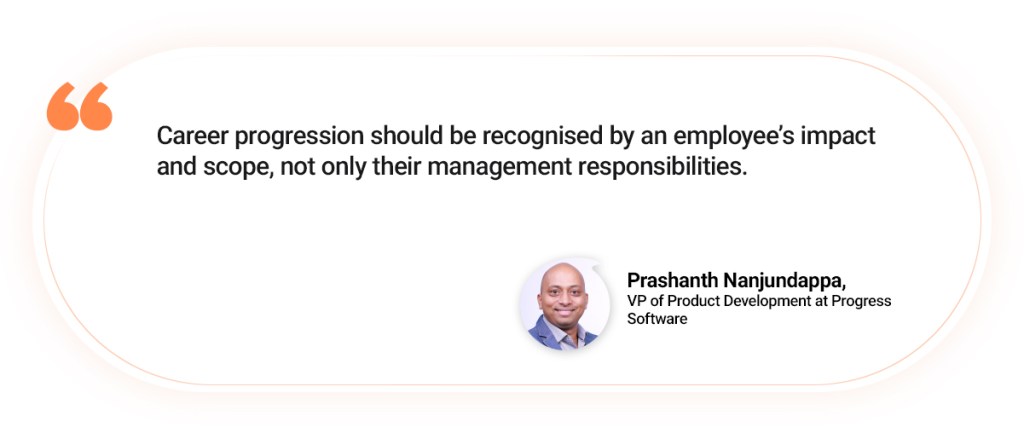
Prashanth stresses dual career ladders, where progression is based on impact, not just people management. “Career progression should be recognised by an employee’s impact and scope, not only their management responsibilities,” he argues. He also advocates for internal opportunity marketplaces that make it easier for employees to explore roles inside rather than outside.
Sandeep agrees, adding: “Culturally, organisations need to move beyond seeing engineers only as builders. Structurally, they must enable flexible pathways, whether in innovation labs, governance, or client strategy roles, that reward the application of technical thinking in non-technical domains.”
For Yadhu Kishore, culture is inseparable from psychological safety by noting, “Organisations must shift from linear career models to dynamic ecosystems. It requires hybrid roles, intrapreneurship programmes, and above all, the psychological safety where unconventional ideas are welcomed and diverse voices are amplified.”
Navaneet emphasises the importance of role-defining mentorship. “Organisations that highlight role models blending technical depth with broader skills inspire others to follow suit, building stronger teams and accelerating growth. Our goal isn’t just to execute tasks; it’s to add value, become decision-makers, and take ownership of priorities,” he says.
Ink Dive: STEMpowerment: How Women in Tech Are Succeeding at Wells Fargo
Programmes and Initiatives that Work
How do these shifts translate into practice? From hackathons to intrapreneurship funnels, leaders point to initiatives that meaningfully engage engineers.
Prashanth points to innovation days, intrapreneurship funnels, and test labs as vital. “When you fund stages of development rather than just ideas, and measure outcomes like time to first learning or pilot graduation rates, you give engineers a structured way to innovate,” he explains.
Yadhu Kishore lists hackathons, codethons, proof-of-concepts, and incubators as key levers. “A lot of organisations now have test labs that promote business ideation. Engineers even get opportunities to pitch solutions like entrepreneurs, connecting technology directly to business problems,” he says.
Sandeep cautions against treating such initiatives as one-off events. “The real differentiator is providing platforms where engineers can apply structured problem-solving in broader contexts — digital transformation, risk management, or even new product lines,” he notes.

Redefining Premium Talent
Perhaps the most provocative question is this: do we need to redefine premium talent to include engineers who move into strategy, leadership, or non-technical roles? All four leaders agree the answer is yes.
Sandeep is unequivocal: “Premium talent should not be limited to those excelling in technical innovation. Engineers who transition into strategy or risk-based roles bring a rare combination of quantitative acumen and cross-domain perspective.”
Yadhu Kishore calls it a necessity: “The definition of premium talent must expand. Today’s most valuable engineers are those who do not just build solutions but envision them, lead cross-functional teams, and drive strategic outcomes.”
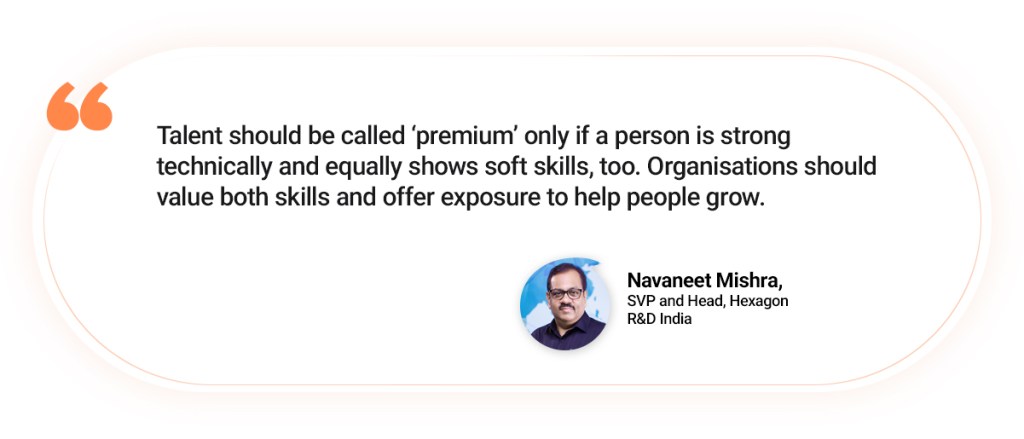
Navaneet adds, “Talent should be called 'premium' only if a person is strong technically and equally shows soft skills, too. Organisations should value both skills and offer exposure to help people grow.” He envisions that this should be a practice not just during hiring, but also for promotions.
Prashanth concludes on a business note by saying, “Companies that truly reward ‘outcome makers’ and create opportunities for engineers to evolve can turn what looks like attrition risk into a powerful long-term advantage.”
The Road Ahead
Engineers’ Day is a reminder of India’s rich tradition of technical ingenuity that commemorates the life and times of the legendary Sir M. Visvesvaraya. But as the leaders remind us, today’s premium engineers are not only coders or builders. They are strategists, intrapreneurs, innovators, and future leaders.
In the age of the Premium Talent Imperative, the organisations that thrive will be those that celebrate this evolution, create structures to support it, and boldly redefine what talent means.
Because the future of engineering is not only about building systems, but about building futures.