

As India cements its reputation as a preferred destination for Global Capability Centres (GCCs), the sector is entering a transformative growth phase that signals both economic opportunity and a reshaping of the talent landscape. With GCCs expected to create one million jobs over the next six years, total employment in this sector is expected to reach a staggering 3.3 million by 2030. Notably, these centres are now outpacing traditional IT services in job generation.
Unlike conventional outsourcing models associated with IT services firms, today’s GCCs are taking ownership of digital transformation efforts in-house. This evolution is diminishing dependence on third-party vendors and shifting the focus towards building robust, future-ready talent pools within India.
According to India's Talent Takeoff — The GCC 4.0 Story, a report by NLB Services, 35% of GCCs are planning workforce expansions of 50–100%. NASSCOM data corroborates this trend, indicating that over 2 million professionals will be employed by GCCs by 2026, with a significant 30–40% of new hires expected to be entry-level talent.
Industries Driving Fresh Talent Demand within GCCs
Within the GCC landscape, certain industries are emerging as key engines for hiring fresh talent. BFSI (Banking, Financial Services, and Insurance), healthcare, retail, and telecom are at the forefront. These sectors are leveraging their capability centres in India to accelerate digital transformation initiatives, from launching customer-centric digital platforms in banking to implementing AI in retail inventory.
Case Studies: Steady Investments by Global Players
Global giants like JPMorgan Chase, Wells Fargo, and Goldman Sachs have significantly increased their hiring from Indian campuses to power their India-based GCCs. Similarly, healthcare leader UnitedHealth Group has set up large capability centres in Bengaluru and Hyderabad, actively recruiting freshers for data analytics, AI/ML, and cybersecurity roles.
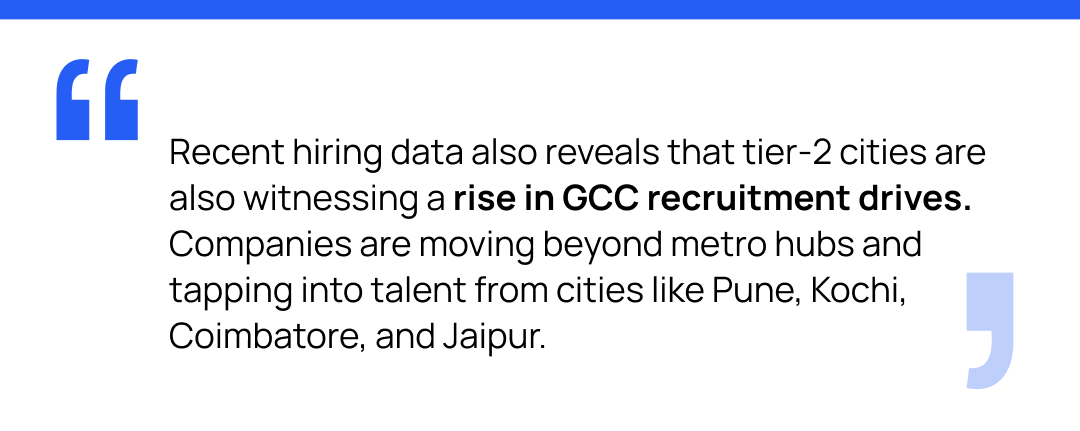
For instance, Wells Fargo’s India GCC is investing heavily in building talent pipelines for roles in cybersecurity and enterprise technology. In fact, two leading global professional services companies have collaborated with Great Learning to train their employees in AI/ML and Generative AI. Recent hiring data also reveals that tier-2 cities are also witnessing a rise in GCC recruitment drives. Companies are moving beyond metro hubs and tapping into talent from cities like Pune, Kochi, Coimbatore, and Jaipur. Additionally, hybrid working models have made it easier for GCCs to diversify their recruitment beyond traditional engineering and business schools to include specialised institutes and coding bootcamps.
Ink Dive: 6-7% Dip in Talent Addition for India’s Pharma GCCs, FY26 Growth Slashed to 12–15%
Skills Roadmap for Freshers Eyeing GCC Roles
As the country strengthens its position as a preferred destination for GCCs, here are some skills for fresh graduates looking to qualify for high-demand positions. These competencies will not only drive tech advancement but will also aid in building resilience in a competitive job market.
- AI/ML for Innovation and Automation: With AI-driven decision-making and automation becoming core priorities, GCCs are using machine learning (ML) and artificial intelligence (AI) to improve efficiency and streamline operations. From AI-powered chatbots to predictive analytics, companies are leveraging these technologies to optimise processes.
Freshers looking to stand out should focus on mastering Python and Natural Language Processing (NLP), which are essential for building chatbots, sentiment analysis, and other AI applications. - Data Science for Decision-Making: As global businesses become increasingly data-driven, GCCs are at the forefront of managing and analysing vast amounts of information. Turning raw data into actionable insights is key to shaping business strategies, making data analytics a critical skill for freshers.
Proficiency in SQL, Power BI, and Python-based analytics will be essential for extracting meaningful insights, identifying patterns, and forecasting trends. - Cybersecurity to Strengthen Digital Infrastructure: Global capability centres in India are increasingly transforming into cybersecurity centres of excellence. According to a NASSCOM report, at 25–27%, the demand and supply gap in India’s technology talent is the lowest among the global technology leaders, including the US, Australia and the UK. GCCs are leveraging this talent pool to build world-class cybersecurity teams capable of addressing complex threats.
Skills in ethical hacking, cloud security, and risk assessment, along with certifications like CEH and CISSP, will be highly valued. - Cloud Computing for Scalable Operations: GCCs are embracing hybrid and multi-cloud strategies to enhance their IT infrastructure, ensuring greater flexibility, scalability, and resilience to meet diverse business needs. GCCs often need tailored solutions that seamlessly integrate with their global technology ecosystem while adhering to local performance standards.
Freshers proficient in AWS, Azure, or GCP will be in demand for roles in cloud engineering, DevOps, and IT infrastructure management.
Ink Dive: Rahul Sahay on Why Virtusa Prefers to ‘Work With AI, Not For It’
India’s GCC journey is not just one of numerical growth but of technological and strategic depth. For freshers, the message is clear: the time to invest in future-facing skills is now. By cultivating the right mix of technical know-how and industry relevance, early-career professionals will not merely enter the job market—they will shape its evolution.
In the race to become future-ready, it is those who learn, unlearn, and re-learn that shall ultimately lead.
Dr Pavankumar Gurazada is an authority in Artificial Intelligence and Data Analytics, combining academic excellence with practical expertise. At Great Learning, he serves as a Faculty Member in Business and AI, leading the development of Generative AI programmes for enterprise clients. He also contributes globally as an Adjunct Lecturer at Northwestern University and the University of Arizona. A published author, his works include Marketing Analytics for Strategic Decision Making (Oxford University Press, 2021) and AI for Business (Vikas Publishing, 2024), both offering actionable insights for business leaders on harnessing analytics and AI for competitive advantage.