

When Dr. Sangeeta Chhabra talks about India’s cloud-AI future, she begins with a caution: young professionals who focus only on coding risk being left behind. At AceCloud, that belief has shaped an ecosystem where engineers dive into GPU computing and AI frameworks, designers simplify complex cloud environments, and everyone invests in continuous learning through 25,000+ courses, AR/VR training, and mentorship. She is frank about the challenges, from interoperability issues in hybrid cloud adoption to the shrinking value of routine programming. Yet she remains optimistic that with interdisciplinary learning, systems thinking, and a culture of diversity, India’s workforce can drive the next wave of the cloud-AI revolution.
For those unfamiliar, what is AceCloud, and how did the idea originate?
AceCloud is a leading provider of end-to-end Cloud infrastructure to global organisations across industries at scale. It offers a full spectrum of Cloud IaaS services, including Public Cloud, Application Hosting, AWS Services, Managed Security Services, and Hosted Virtual Desktop Solutions. AceCloud is a brand of the Real Time Data Services (RTDS) group of companies — a leading provider of information technology capabilities specialising in Cloud Computing and Cloud Telephony. The RTDS Group has an employee base of 600+ across India, the US, and the UK, supporting more than 20,000 customers, with IT infrastructure in 10+ data centres spanning the globe. It offers industry-leading technological solutions that help customers streamline their operations and enhance efficiency.
The idea originated from the growing need for enterprises, especially SMBs and mid-market firms, to access enterprise-grade cloud services without the complexity and cost typically associated with large-scale deployments. The vision was to simplify cloud adoption, make advanced infrastructure accessible, and support businesses in their digital transformation journeys.
India’s cloud ecosystem is rapidly maturing, but talent remains the biggest bottleneck. From your vantage point at AceCloud, what unique challenges do you see when aligning India’s vast talent base with the specialised demands of AI-driven cloud infrastructure?
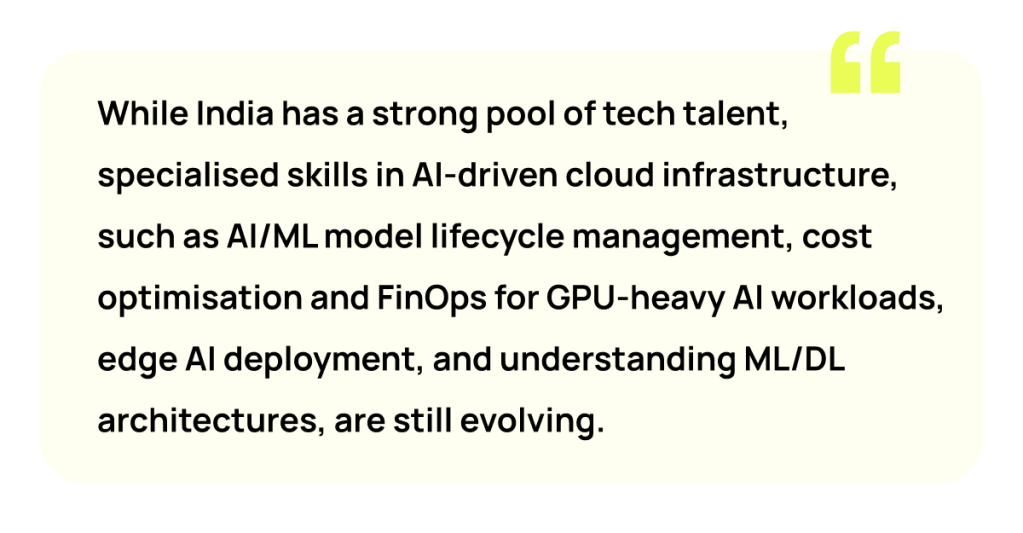
The biggest challenge is bridging the gap between theoretical knowledge and real-world application. While India has a strong pool of tech talent, specialised skills in AI-driven cloud infrastructure, such as AI/ML model lifecycle management, cost optimisation and FinOps for GPU-heavy AI workloads, edge AI deployment, and understanding ML/DL architectures, are still evolving.
Upskilling at scale and creating hands-on exposure remain key hurdles. Another challenge is retaining skilled professionals, as demand outpaces supply, making continuous training and partnerships with academia and industry critical.
With 85% of organisations in the Asia-Pacific region already deploying workloads in hybrid environments, hybrid adoption in India is strong but fraught with challenges. What are the biggest operational or talent-related pitfalls you see, particularly around interoperability, latency, and other blind spots that companies often fail to anticipate when scaling hybrid cloud adoption?
One major pitfall is that underestimating interoperability issues, ensuring that on-premise systems, public cloud, and private cloud environments can seamlessly communicate, is often more complex than expected. Latency also becomes a challenge when workloads are not optimally distributed across regions or providers. On the talent front, many organisations struggle with building teams that can manage hybrid environments end-to-end, including governance, monitoring, and security. Companies often overlook change management and training, leading to inefficiencies, higher costs, and security vulnerabilities during scaling.
AI-driven automation often promises efficiency, yet many enterprises face hidden costs in monitoring, scaling, and talent retraining. How should leaders realistically budget for these challenges?
AI-driven automation is often celebrated for efficiency, but the real investment begins after deployment. Systems need constant oversight, scaling as the business grows, and teams who are confident in working with them. Many organisations underestimate this and realise that retraining is not a one-time activity but a recurring necessity.
Leaders who plan effectively build stronger systems by budgeting not only for infrastructure but also for the scaffolding around it — governance, monitoring, and continuous learning. At AceCloud, learning and upskilling are part of our culture, with access to more than twenty-five thousand courses, ensuring automation translates into long-term, sustainable value.
Ink Dive: The Growing Role of WhatsApp as a Core Enterprise Tech & HR Integration Tool
India produces a vast pool of generalist cloud engineers, but lacks sufficient niche experts in areas such as AI orchestration, container security, and distributed data pipelines. How can AceCloud and similar organisations prevent this over-supply of ‘surface-level’ talent?
India has built an impressive workforce in cloud technologies over the past decade, but much of it remains at a generalist level. The real gap is in specialists, the experts who can design secure container environments, orchestrate complex AI systems, or manage large-scale data pipelines. Without such depth, enterprises will struggle to unlock the full potential of advanced cloud and AI solutions.
At AceCloud, we believe learning should be continuous, not reactive. Our teams have access to over 25,000 courses, ranging from foundational skills to advanced areas such as generative AI engineering, distributed computing, and cybersecurity. We complement this with hands-on projects, because true expertise only develops when knowledge is applied in practice. To close the skills gap, businesses and academia must work together on industry-aligned curricula, mentorship, and applied research. Generalists gave India its foundation, but specialists will define its future.

How do you assess whether upskilling initiatives in India are genuinely future-proof, or whether they are simply chasing today’s certifications?
Many upskilling programs in India tend to follow short-term trends, a cloud certification or a new language, without asking if those skills will still matter a few years later. A certificate may look impressive, but it is not future-proof unless it builds the ability to keep adapting.
Technology changes faster than we expect. Generative AI, which was once seen as experimental, is now central to business conversations. This shows that readiness is less about today’s tools and more about nurturing curiosity, flexibility, and continuous learning.
At AceCloud, we embed this approach by offering continuous learning courses, from AI engineering and cybersecurity to leadership and problem-solving, and ensuring they apply learning in real projects. True resilience comes from ongoing development, not one-time training.
With sensitive workloads moving into the cloud, India faces unique challenges around regulatory compliance and data sovereignty. How does this impact the kind of skills companies should be developing in-house?
India's regulatory and governance competencies involve a wide array of skills necessary for formulating, implementing, and managing market rules, such as knowledge of regulatory environments, stakeholder management, Regulatory Impact Assessments (RIA), and project management. Some of the major elements include a profound understanding of the Indian economic and legal context, the capacity to enable compliance and innovation, and competence in applying data and digital tools towards improved regulatory outcomes. There is a need for continuous learning and responsiveness to ever-changing market requirements, enabling regulators to provide effective regulation without hampering business development.
At AceCloud, we are addressing these evolving needs by building a workforce proficient in both cutting-edge technology and adaptive problem-solving. Our engineers specialise in cloud infrastructure, AI, ML frameworks, GPU-accelerated computing, Kubernetes, Docker, and APIs, while our designers focus on user experience and data visualisation to simplify complex cloud environments.
AceCloud is positioning itself not only as a solutions provider but also as a talent enabler. Could you share specific investments or initiatives AceCloud has undertaken to build a future-ready workforce, and how these align with India’s broader digital ambitions?
At AceCloud, we focus on engineers who are skilled in cloud infrastructure, artificial intelligence, machine learning frameworks, GPU computing, Kubernetes, Docker, and APIs, while designers need to master user experience and data visualisation to simplify complex cloud interfaces. We invest heavily in continuous learning to remain ahead of changing technology. Through Udemy and internal training portals, our associates have access to over 25,000 courses in various areas, including generative AI, cloud computing, data science, security, and leadership. Periodic knowledge-sharing sessions and participation in international tech forums keep our teams at the leading edge.
We have also built personalised learning and career acceleration programmes, mentorship frameworks, and HR Connect sessions to track progress. Building a future-ready workforce also means embedding DEI into upskilling efforts. We integrate AI-driven bias detection in evaluations, create AR/VR-based cloud training modules, and enable AI-powered career platforms for personalised learning. Cross-industry mentorship circles and active engagement with industry networks ensure diverse perspectives and equal opportunities.
If you had to advise young professionals entering the cloud-AI domain, what one mistake should they avoid and what one mindset should they adopt to remain relevant in the next decade?
The biggest mistake young professionals can make is narrowing their focus solely to coding. Routine programming is rapidly being automated, reducing demand for conventional software roles. A computer science degree alone, especially from undifferentiated colleges, will no longer guarantee access to high-skill cloud-AI jobs.
The mindset to adopt is interdisciplinary learning. Engineers who understand both computational intelligence and domain-specific challenges will continue to remain in demand. Staying relevant requires continuous upskilling, systems thinking, and looking beyond traditional software into areas where AI is transforming physical industries.
Dr. Sangeeta Chhabra is the Co-Founder & Executive Director of AceCloud (a brand of RTDS), a leading provider of cloud solutions for global enterprises. With over three decades of experience spanning academia and entrepreneurship, she manages day-to-day operations while working with C-Suite leaders on strategic initiatives. A Ph.D. in Business Management and an alumna of the Delhi School of Economics, her research on issues such as MGNREGA and unaccounted wealth has been nationally recognised, with over 20 publications in reputed journals. At AceCloud, she is equally committed to fostering diversity and inclusion, championing women’s empowerment, and building a supportive, future-ready workforce.