

AI conversations in the workplace often begin with productivity, but increasingly, they are becoming conversations about how organisations themselves are being redesigned. At ZS, where nearly 70% of the workforce is based in India and a significant share is Gen Z and AI-native, that shift is already visible across workflows, talent strategy, and leadership thinking. In this conversation, Neha Arur, Senior Director and Regional Human Resources Lead at ZS, speaks about what organisations may need to ‘unlearn’ in the AI era, why human judgement still matters, and how companies are balancing digital transformation with deeply human-centred decision-making.
AI is often discussed as a productivity tool, but its real impact seems to be on how work itself is structured. At ZS, where have you seen AI fundamentally change the way work is designed, not just how efficiently it is executed?
If I were to begin with our vision statement at ZS, it captures this shift quite well. It says, “ZS partners with companies to improve life and how we live it. We transform ideas into impact by bringing together data, science, technology and human ingenuity to deliver better outcomes for all.”
The keywords there are data, science, technology and human ingenuity. Today, everything we deliver for our clients, and even the way we design work internally, is deeply tied to that philosophy. AI is not just an efficiency tool for us. It is becoming central to how we deliver business outcomes to clients. As a consulting company, AI naturally disrupts many traditional ways of working. Yes, it has created efficiencies, but more importantly, it has augmented the quality of judgement and consulting we bring to the table.
It is also influencing how we build skills across the organisation, from awareness and adoption of AI capabilities to giving teams access to the right tools and encouraging innovation in day-to-day workflows. Ultimately, the real impact shows up in how we deliver services to clients and how teams collaborate and solve problems. Hence, for us, AI is no longer adjacent to the business. It is becoming integral to the way we operate and create value today.
ZS positions itself as a leader in skills-first workforce strategy powered by AI and analytics, so can you share an instance where this approach led to a clear business shift, whether in client outcomes, speed of delivery, or quality of decisions, rather than simply improving internal efficiency?
Absolutely. One area where we have seen significant disruption is in our work with leading pharmaceutical companies, which remains a core part of our business. For instance, market research has evolved dramatically with the advent of AI. Traditionally, if you were conducting physician research, you would build a database of perhaps 200 physicians and engage them directly to gather insights and opinions.
Today, the way we approach and deliver that work has fundamentally changed. We now have tools that can reduce a project timeline from 12 weeks to around eight weeks, which is already a significant gain in speed and efficiency. But beyond that, AI is also changing the scale and quality of insight generation. For example, instead of relying entirely on outreach to hundreds of physicians, digital twins can now generate data with nearly 95% accuracy. That has created substantial efficiencies in both effort and cost.
However, the real differentiator for us is not access to the technology itself, as many organisations already have access to similar tools today. The real value lies in how the output is interpreted and translated into meaningful consulting advice for clients. Our clients continue to work with us because they expect sound judgement, contextual understanding, and recommendations that actually make sense for their business.
That is where the nature of skills is also evolving. Earlier, certain consulting or analytical capabilities may have taken 18 months to build through experience and repetition. Today, AI can accelerate parts of that journey. Someone may no longer need to code every process manually, but they still need to evaluate whether the output is reliable, enterprise-grade, unbiased, and relevant to the client. The emphasis is shifting from effort-based work to judgement-led work.
We are seeing this disruption across multiple areas of the business. Market research is one example, forecasting is another. AI-native workflows are increasingly becoming part of how we operate, allowing us to scale work differently while still retaining a strong layer of human judgement and quality assurance. In some cases, we have seen businesses grow in double-digit revenue terms without proportionately increasing headcount, simply because the underlying processes have become significantly more efficient and intelligent.
Ink Dive: From Storytelling to Truth-Telling: Arti Gangaiya on Building an Employer Brand Gen Z Trust
Many organisations claim AI-driven transformation, yet the underlying hierarchies and decision-making models remain unchanged. Do you think most companies are redesigning organisations for AI, or simply layering AI onto legacy structures? Where does ZS stand?
That is a very interesting question. If I step back and look at the broader industry landscape through the forums and conversations I participate in, I think the picture is still quite heterogeneous. Different sectors are embracing AI at very different levels of maturity. Consulting and professional services may approach it differently compared to manufacturing, banking, or other industries.
At times, there is also confusion around what truly qualifies as AI transformation. For some organisations, implementing a new enterprise system is still seen as ‘AI adoption.’ Alongside that, there is also a natural cycle of scepticism and anxiety. AI creates uncertainty for many people because they struggle to see where they fit into the future of work. But if you look at history, we have gone through several technological revolutions before. We moved from paper-based work to digitised systems, then to smarter systems, then to the internet and social media era. This is another major shift in that continuum.
Some organisations will naturally adapt faster than others because resistance to change is human. Similarly, some industries will embrace AI sooner because it directly strengthens their business strategy. What is different this time, however, is the pace of disruption. Even six months can completely change the landscape. For example, in late 2025, we were still evaluating which AI tools to roll out more broadly across teams. Today, the ecosystem has evolved dramatically in a very short span of time.
At ZS, we are seeing this shift play out very actively. Over the last few months alone, our teams have built nearly 7,000 AI agents internally. Even within HR, there are examples where processes like global payroll, which previously relied heavily on manual Excel-based work and multiple layers of review, have been significantly transformed. A lot of repetitive QC and review work has now been automated, freeing people to focus on more analytical and higher-value tasks rather than effort-driven execution.
We often use what we call the ‘Tony Stark’ analogy at ZS. AI is like J.A.R.V.I.S., but there is still a human inside the suit. AI amplifies human capability, but without the person driving it, it remains just a tool. That is really how we think about the balance between digital workforce transformation and a deeply human-centred approach.
Since AI is increasingly influencing decisions that were traditionally human-led, how is it changing the locus of decision-making within organisations, and what does that mean for leadership roles?
I think the strategic intent behind work is becoming much more important across levels today. Earlier, organisations often operated in layers. One layer would handle a significant amount of effort-based or repetitive work, another would review and quality-check that work, and then a smaller leadership layer would focus on strategic direction and decision-making. With AI automating a large part of the repetitive, process-heavy tasks, the shift is now moving towards more strategic and unstructured thinking.
At ZS, we often encourage people to think about their work through three lenses. The first is framing the problem correctly. Every day, we ask our teams to think deeply about what problem they are actually solving, whether it is for a client or an internal business challenge. I often say that the economy has shifted from answering questions to asking the right questions. Earlier, success depended on having the right answer. Today, information and outputs are widely accessible. The differentiator is knowing what to ask, what truly matters, and whether the problem being solved is meaningful and sustainable in the first place.
The second aspect is around iteration and perseverance. Once you frame the problem, AI can certainly help generate outputs quickly. But the first output is rarely the best one. It takes continuous refinement, training, repetition, and judgement to improve the quality and relevance of those outcomes. A lot of effort now goes into building workflows that are sustainable, efficient, and genuinely usable.
The third aspect is judgement. In consulting, an output cannot simply be shipped to a client because a tool generated it. The real value lies in interpreting it, contextualising it, and ensuring it actually works in a business environment. So we constantly ask ourselves: how do we frame the right strategic problem, improve the workflow continuously, and then apply sound judgement to deliver a meaningful solution?
I would not say everybody has fully transitioned into this way of thinking yet, because the pace of disruption is extremely fast. But what we are seeing is that when people are given the right frameworks, tools, and direction, they are highly motivated to build these capabilities themselves. We hire analytically strong talent, and there is already a strong culture of self-learning and experimentation. Our role increasingly is to create the right environment, provide the right tools, and help people navigate the journey.
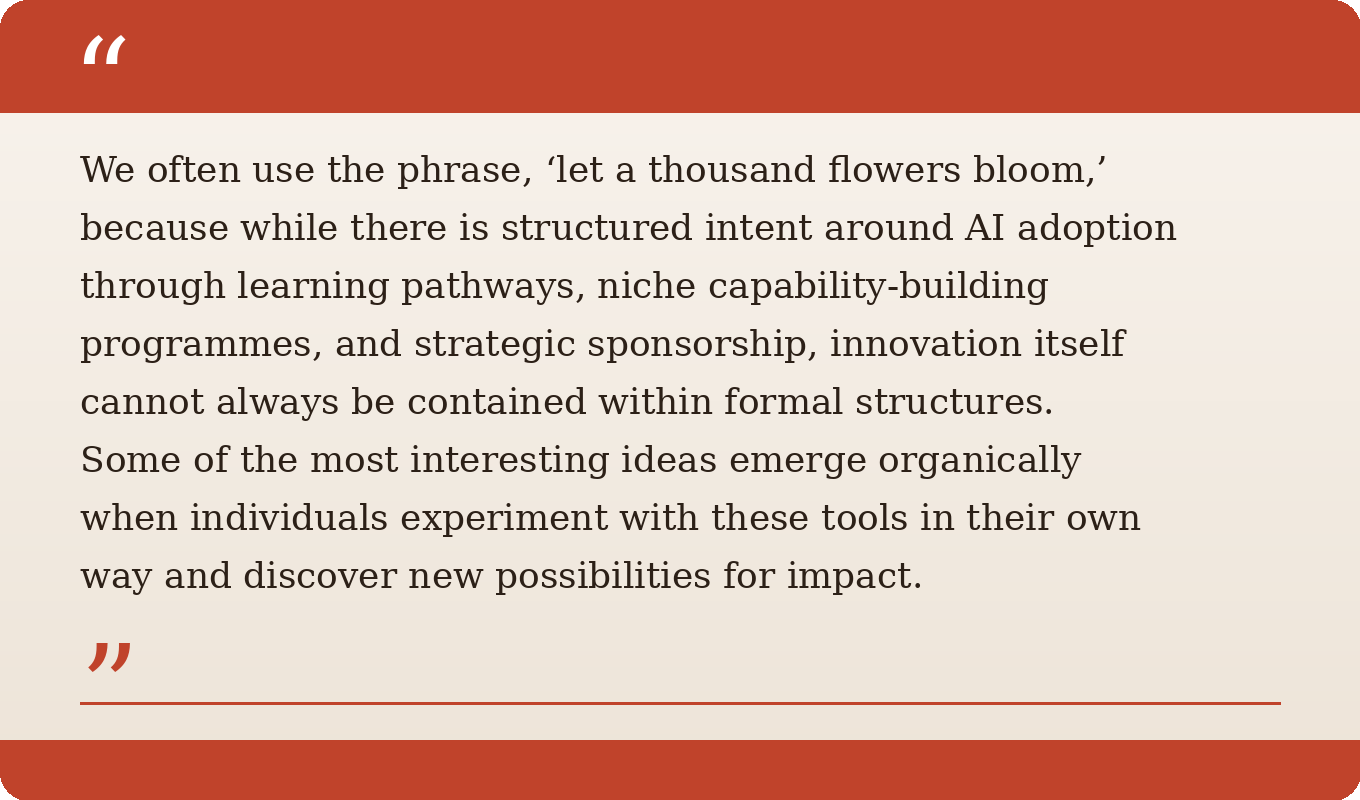
There is also a strong balance between top-down direction and bottom-up innovation. We often use the phrase, ‘let a thousand flowers bloom,’ because while there is structured intent around AI adoption through learning pathways, niche capability-building programmes, and strategic sponsorship, innovation itself cannot always be contained within formal structures. Some of the most interesting ideas emerge organically when individuals experiment with these tools in their own way and discover new possibilities for impact.
So from a leadership and skills perspective, I think the shift is very clear. Strategic thinking, comfort with ambiguity, problem framing, and the ability to persevere with evolving solutions are becoming critical capabilities at every level of the organisation.
Where do you personally draw the line between machine-led insight and human judgement?
Interesting, as sometimes I feel that perfect English writing is no longer a differentiating skill because AI can generate extremely polished outputs very quickly. But even today, when some team members write to me, I can immediately sense the difference between something that is technically perfect yet lacks context, and something that genuinely makes sense in a business setting. That contextualisation is still incredibly important.
I do not think we are at a stage where human judgement can simply be replaced by AI-generated output. AI can give very confident answers, but confidence does not always mean correctness or relevance. I once heard a funny example where someone asked AI, “There is a car wash right next to my house. Should I take my car or walk?” and the AI confidently responded, “Walk.” It sounds amusing, but it also highlights the larger point. AI may produce an answer, but understanding the context behind the question is still deeply human.
I experienced something similar while creating case studies recently. What might have taken me two days earlier could now be generated much faster with the help of prompts and AI tools. But I still could not use the output directly because it needed significant contextualisation to suit the organisation and the actual business requirement. That layer of interpretation, judgement, and relevance-building is where humans continue to make the biggest difference.
A Gartner study once made a very interesting point: if you reduce people to simply a bundle of tasks, then yes, AI can take over many of those tasks. But work is rarely just a collection of tasks. Creativity, nuance, judgement, and contextual understanding are much harder to replace. That human layer still matters enormously.
I will give you another funny example. A senior leader who had just taken on a new role told me he had used AI to prepare for conversations with different teams, such as HR and finance. He asked AI to generate the questions he should ask each function. I jokingly told him, “Great. Send me those questions, my AI can answer them, and we’ll say it’s mission accomplished.” We had a good laugh about it because it almost felt like AI systems speaking to each other through us. But that is also where the human element becomes important because ultimately, meaningful conversations and decisions still depend on interpretation, relationships, and judgement.

AI is often positioned as a tool for more objective and inclusive decision-making. In practice, have you seen AI reduce bias in organisations, or does it risk embedding bias in more sophisticated ways?
I do think AI can create bias if left unchecked, especially when organisations begin accepting outputs blindly without questioning how those outcomes are being generated. A few years ago, for instance, there were AI-led hiring tools in the market that claimed they could assess competencies through facial expressions, tone, and behavioural cues during interviews. While the intention may have been objectivity, many of these systems ended up revealing bias due to how the algorithms were trained or the benchmark data they relied on.
So if the underlying data, framing, or norm groups are flawed, the output can also become flawed. That can directly impact hiring decisions, selections, and broader talent outcomes. Which is why I believe there always has to be a strong layer of checks and balances around AI-generated insights.
At the same time, AI can also create more inclusion in certain ways. I think organisations are going to rethink parts of their talent strategy quite significantly. Earlier, hiring could often be very pedigree-led or shaped by very specific backgrounds. Today, some skills are becoming more democratised. For example, coding itself may no longer remain the differentiator it once was because AI can support many of those tasks. Instead, organisations may increasingly value capabilities such as storytelling, consulting, problem-solving, and contextual thinking, even from people without traditional engineering backgrounds. In that sense, AI can open up opportunities for more skill-driven and inclusive hiring models.
But yes, the risk of bias absolutely remains. At ZS, because we work so closely with data, one of the principles we constantly reinforce is ‘garbage in, garbage out.’ The quality of the output depends heavily on the quality of the data, assumptions, and framing that go into the system. We encourage teams to continuously question what the data is actually telling them rather than accepting outputs at face value.
For example, if nine out of ten data points suggest one thing, does that automatically make it true? Or could the one outlier contain an insight that is actually more important? Human judgement becomes critical in deciding what is contextual, what is high impact, and what truly matters. Algorithms alone may not always capture those nuances unless they are continuously trained and refined thoughtfully.
I have also seen this in employee listening exercises within HR. Sometimes, when you feed large volumes of emotional or qualitative feedback into AI systems, the output becomes extremely polished and generic. It starts sounding like feedback that could apply to any organisation. However, in the process, you risk losing the essence or emotional truth behind what people are actually saying. The soul of the insight can disappear. So while AI is incredibly powerful at synthesising information, human intervention is still essential to preserve context, meaning, and authenticity.
What feels more scarce today—good talent, or the ability to use AI meaningfully?
I think both are scarce today. As I mentioned earlier, we have only recently rolled out many of these AI tools more broadly, so naturally, people are coming in with very different levels of exposure and familiarity. Some may already have experience with certain tools, while for others, the adoption journey is just beginning. So awareness and adoption are both very critical at this stage.
There is a strong push across functions for everybody to start engaging meaningfully with AI, regardless of role. At the same time, organisations cannot rely entirely on external hiring because this is still a very new capability area. You cannot simply ask the market for someone with 10 years of AI expertise at scale because, realistically, that talent pool does not fully exist yet.
So there is definitely a talent war underway. Across industries, whether services or product companies, everyone is trying to hire from the same pool of talent. We are seeing the effects of that in terms of scarcity, offer shopping, and intense competition for skilled professionals. But there is also a limit to how much organisations can depend only on buying talent externally.
For me, the balance is important. If 30% of the effort goes into hiring talent, then 70% has to go into building talent internally. That could range from foundational AI awareness all the way to highly advanced capabilities. For organisations where AI is becoming central to business strategy, continuous learning and capability-building need to be the core focus. And then, of course, for the skills you cannot build fast enough internally, you still have to go to the market, even though it is an extremely competitive space right now.

Three years from now, what will organisations have to fundamentally ‘unlearn’ about talent strategy to stay relevant?
I think one of the biggest things organisations will have to unlearn is the idea that the workforce is made up only of people. Increasingly, teams will include both human and digital workers, or what you could call bot subordinates, alongside human subordinates. That fundamentally changes how organisational structures, hierarchies, and talent strategies are designed.
Today, especially in consulting and IT services, many operating models are still built around traditional project structures, effort estimates, and pyramid-based workforce planning. But those constructs are already beginning to shift. The question is no longer just how many people you need at each level, but how human capability integrates with AI-driven systems and digital workflows. HR functions will also need to evolve significantly in how they manage these hybrid ecosystems of human and digital workforces together.
I believe organisations will have to move away from quantity-led thinking towards quality and impact-led thinking. Earlier, growth was often tied to adding more people to deliver more work. Increasingly, the focus will shift towards the skills, judgement, and outcomes a team can deliver rather than simply the scale of headcount.
At the same time, AI is disrupting almost every product, platform, and workflow we use today. So, irrespective of function, the nature of roles will change quite dramatically. And honestly, it is difficult to predict exactly what will happen three years from now because the pace of change is so rapid that things evolve every six months.
But one trend feels very clear to me: organisations will continue to grow, but they will grow through very different workforce models. Hybrid workforces, flatter or reimagined pyramid structures, and skill-driven talent models will become far more common. Skills will increasingly become the real currency of value. Even professional services firms will likely rethink how they deliver value to clients, moving beyond traditional effort- or billing-led models towards more intelligent, efficiency-driven, and outcome-oriented ways of working. Those are definitely some of the shifts we are already beginning to see in the market.
Neha Arur is Senior Director and Regional Human Resources Lead at ZS, where she leads training, talent acquisition, and career development initiatives aligned with the company’s long-term growth agenda. With over 22 years of experience across mid-sized enterprises and high-growth global organisations, she has led large-scale projects, multi-country operations, and business transformation initiatives. Neha is passionate about building inclusive, people-centric workplaces and driving talent strategies that strengthen employee engagement, development, and retention.