

As organisations move deeper into an AI-enabled future, this HR Day’s theme, Empower People to Lead Change, shifts the spotlight to a pressing leadership question: how do we ensure that as AI automates execution, the distinctly human qualities that drive judgement, creativity, empathy, and contextual thinking become even stronger at work? This is no longer a conversation about adopting new tools, but about redesigning how organisations hire, measure performance, enable learning, and shape culture so people are not merely adapting to AI, but confidently shaping how it is used.
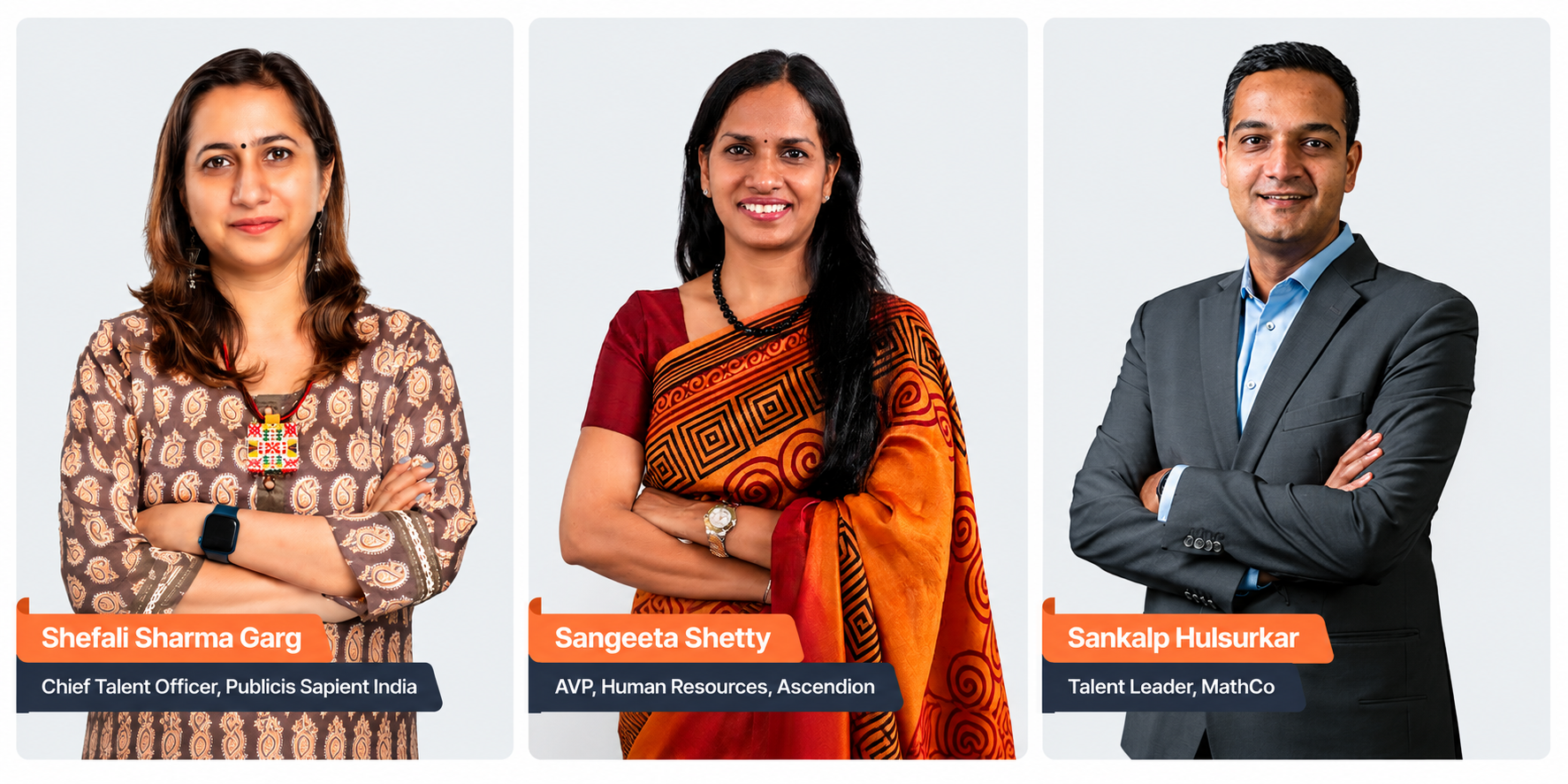
In this leadership feature, Sankalp Hulsurkar, Talent Leader at MathCo, Shefali Sharma Garg, Chief Talent Officer at Publicis Sapient, and Sangeeta Shetty, Associate Vice President – Human Resources at Ascendion, share how HR must preserve the human edge in an AI-first workplace.
The three questions posed to leaders were:
- As AI takes over execution, what distinctly human capabilities are you now prioritising in hiring, development, and leadership pipelines, and how are you measuring them beyond traditional KPIs?
- Where have you seen over-automation dilute judgement, empathy, or creativity at work, and what deliberate steps is HR taking to restore the human balance?
- If empowering people to lead change is the mandate, what structural, cultural, or policy shifts must organisations make so employees do not just adapt to AI, but confidently shape how it is used?
What follows is how three talent leaders are answering these questions, not in theory, but through the changes they are already making to hiring, learning, performance, and culture inside their organisations.
If AI Is Doing the Work, Humans Must Redefine the Value
Sangeeta Shetty
AI is changing what makes people valuable at work. Earlier, execution was the key differentiator. Today, execution is accessible to everyone.
We now prioritise people who can navigate ambiguity, apply context, exercise judgement, and take responsibility for outcomes. Beyond functional expertise, this includes systems thinking, creativity, emotional intelligence, ethical reasoning, and the ability to solve problems across disciplines. AI can generate options quickly, but humans decide what is relevant and responsible.
This shift is also redefining how we measure performance. Traditional productivity metrics are no longer enough in an AI-augmented workplace. We focus more on how individuals:
- Leverage AI to improve quality and outcomes
- Validate and contextualise outputs
- Manage risk and ensure responsible use
- Collaborate effectively
- Create tangible business impact
At Ascendion, every employee carries a companywide AI growth KPI, reinforcing accountability. AI is not reducing the value of human capability; it is making it more visible.
Shefali Sharma Garg
As execution becomes increasingly automated, the capabilities that matter most are distinctly human. The ability to apply judgement in ambiguous situations, think across systems, solve problems in context, and collaborate across boundaries is becoming far more valuable than narrow, role-based expertise.
In an environment where skills can become outdated within months, organisations cannot rely on static definitions of capability. The focus has to move towards building learning agility, curiosity, adaptability, and the ability to apply knowledge in new situations continuously.
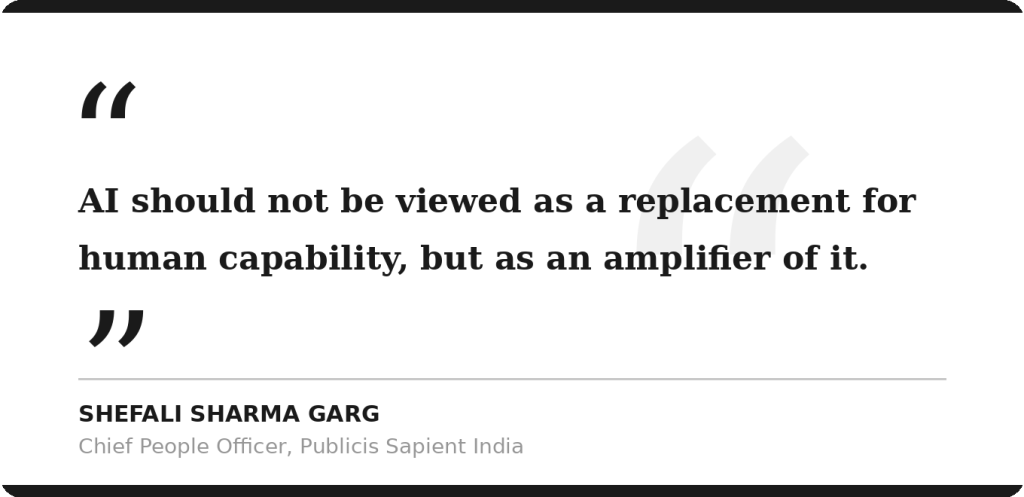
This is where the idea of a Human + AI workforce becomes important. AI should not be viewed as a replacement for human capability, but as an amplifier of it.
Sankalp Hulsurkar
As AI handles execution, we are doubling down on what makes humans irreplaceable.
We are hiring and developing for judgement over knowledge, the ability to step into ambiguous situations and figure things out from first principles rather than simply apply what has already been learned.
With AI as everyone’s personal executor, the real skill is knowing what to ask, what to delegate, and where to push back. Clarity of thought, structured problem framing, and the ability to anticipate second-order consequences are now core competencies, not soft skills.
Our hiring process reflects this. We assess prompting quality, decision-making under uncertainty, and the ability to map outcomes before acting. We measure these through scenario-based evaluations rather than traditional KPIs.
The future belongs to people who can think in systems, learn quickly, and direct powerful tools with precision. AI raises the ceiling, and the best humans will rise with it.
When Speed Takes Over, Thinking Quietly Disappears
Sangeeta
Over-automation becomes a concern when AI is layered onto existing workflows without rethinking how work should change. Teams may become faster, but not necessarily better, losing reflection, empathy, and creative exchange that come from human discussion. At Ascendion, AI is used to accelerate delivery, not remove human responsibility. Decisions around governance, ethics, escalation, and accountability remain human-led.
HR is redesigning roles to ensure stronger oversight, encouraging teams to validate AI outputs, and rebuilding manager capability around listening, coaching, and contextual judgement. We are also creating more space for conversation, collaboration, and reflection instead of optimising everything for speed. Ultimately, the future of work will be defined not by how much we automate, but by how consciously we protect and strengthen human qualities that technology cannot replicate.
Shefali
At the same time, there is growing recognition that over-automation, if left unchecked, can dilute the very qualities organisations are trying to strengthen.
When efficiency becomes the only metric, there is a risk of losing depth of thinking, empathy in interactions, and originality in problem-solving. This is not a failure of technology, but of how work is redesigned around it.
The response cannot be to slow AI adoption, but to embed it more intentionally.
Psychological safety becomes critical in this environment. People must feel confident experimenting with AI while also being empowered to question outputs, challenge assumptions, and bring their own perspectives to decision-making. Without that balance, organisations risk creating compliance with AI rather than intelligent collaboration alongside it.
Sankalp
Over-automation becomes a problem when speed replaces thinking. When AI hands you an answer, the temptation is to accept it and move on. Repeated often enough, this erodes judgement, curiosity, and the discipline of figuring things out independently. The productivity chase makes this worse. Optimising for output volume pushes people towards AI as a shortcut rather than a tool.
We have moved away from productivity-only measurement towards outcome-based evaluation. The question is no longer how much was done, but what changed as a result.
Our learning programmes are rebuilt around fundamentals, designed to create space to engage, unlearn, and relearn from the ground up.
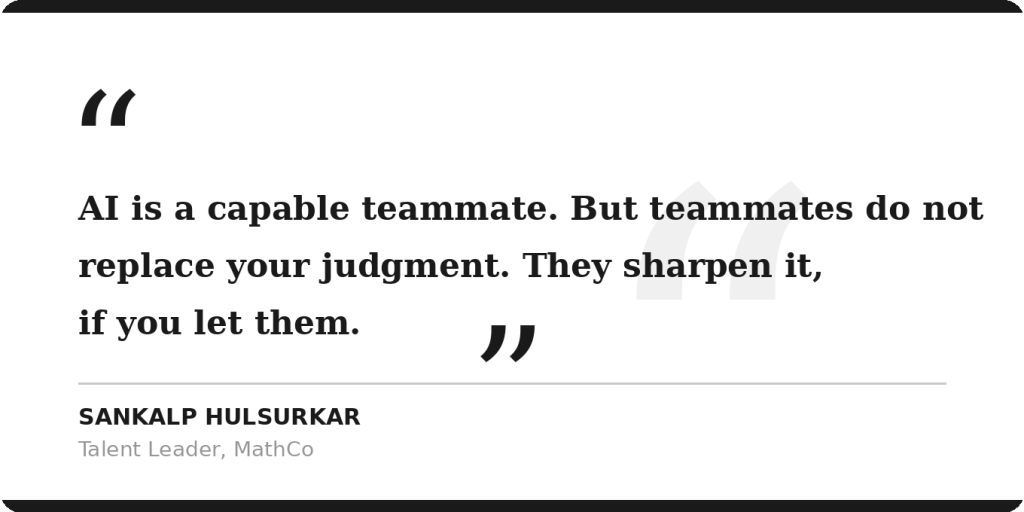
AI is a capable teammate. But teammates do not replace your judgement. They sharpen it, if you let them.
Ink Dive: Beyond Inclusion Theatre: A Women’s Day Special Feature
Using AI Is Easy. Shaping How It Is Used Is Leadership

Sankalp
Empowering people to shape AI, not just use it, requires deliberate choices. Reskilling with intent comes first. What matters is not understanding every AI capability, but knowing how to work with it in your specific context. Collaboration skills will matter more than the breadth of what AI can do.
Roles must also evolve. An analyst today cannot only execute. They need to operate a level above, validating outputs, questioning assumptions, and owning the judgement behind the result. AI handles the build; humans own the verdict.
Clarity becomes a core organisational skill. The quality of what AI produces depends entirely on the context and instructions your people provide.
The cultural shift is simple. AI is not the decision maker. It is the accelerator. Organisations that internalise this will build people who lead, not just keep up.
Sangeeta
Employees can shape AI only when they are involved in how it is designed, governed, and applied to work. They need to be more than tool users and have the context and confidence to influence how AI changes outcomes. Structurally, this means moving towards cross-functional, outcome-led teams where people and AI agents work together with clear ownership and accountability.
Culturally, organisations must create space for employees to experiment, question outputs, and share feedback without hesitation. AI adoption works best when people feel responsible for improving the system, not just complying with it.
From a policy standpoint, clear guardrails are essential on where AI can be used, where human accountability is non-negotiable, and how ethical concerns such as bias and privacy are handled. At Ascendion, AI accelerates execution while people define intent, assess risk, and make final decisions. The goal is not just to help people adapt to AI, but to help them shape it with confidence and purpose.
Shefali
This also requires rethinking how growth and learning happen. Episodic training models are no longer enough. Learning must become continuous, contextual, and embedded in the flow of work.
Through approaches such as Enable Your Potential, organisations are shifting from episodic talent management towards continuous talent enablement, where employees can build skills, access opportunities, and shape their own growth journeys in real time.
Ultimately, empowering people to lead change requires more than investment in technology. It demands structural and cultural shifts that create space for experimentation, widen access to decision-making, and value influence, adaptability, and problem-solving as much as execution.
The organisations that will lead in the AI era will not be the ones that automate the fastest, but the ones that invest most deeply in building the confidence, capability, and agency of their people to shape how AI is used.
On this HR Day, the message from these voices is clear: while AI is transforming how work gets done, HR is shaping how people think about the work that must be done. Because in the end, AI can execute — but it is people, enabled by thoughtful leaders, who decide what is worth executing.