


Prologue
By the second week, she already knows the rhythm of the place.
Which meetings start on time.
Who speaks first.
Who apologises before disagreeing.
Who does not need to.
She has watched how decisions are explained.
She has noticed who gets credit.
She has seen who logs off without commentary and who stays visible just a little longer.
The website had spoken about inclusion.
The offer letter promised growth.
The leadership video talked about voice and flexibility.
But none of that is what shaped her opinion.
It was the pauses.
The tone.
The glances across the table.
By Day 45, she is no longer observing casually. She is paying attention.
By Day 90, she does not need another presentation to know where she stands.
What Leaders Think Their EVP Says — and What Gen Z Women Hear in 90 Days
This International Women’s Day, as the global theme calls on organisations to Give to Gain, All Things Talent turns the lens inward. What are leaders truly giving before they expect trust, engagement and loyalty in return?
The question aligns directly with ATT’s ongoing editorial focus on Employer Value Proposition and the Gen Z mindset. Across industries, organisations are investing heavily in EVP articulation. But Gen Z does not experience EVP as language. They experience it as behaviour. Particularly Gen Z women, who read early signals of credibility, fairness and psychological safety with remarkable precision.
To explore this intersection, ATT posed five direct questions to leaders from various sectors:
- In the first 90 days, which parts of your EVP are most likely to be tested rather than believed, and where has reality challenged intent?
- What early organisational signal do Gen Z women pick up on faster than leaders anticipate?
- From a leadership standpoint, what have you had to consciously give up to build credibility with Gen Z women?
- Have early employee experiences ever forced you to rethink an EVP assumption you were confident about?
- Ultimately, what do leaders gain when EVP is experienced as truth rather than theatre, and what is the cost when it is not?
The responses that follow are not theoretical. They are reflective, sometimes uncomfortable and deeply operational.
This feature brings together insights from:
Bhavna Batra – Vice President – People, S&P Global | Bhavya Sharma – Vice President - HR & Employer Branding (Tech & Product), Zepto | Jaya Virwani – Chief Wellbeing Officer and Inclusiveness Leader, EY GDS | Neha Chopra, Managing Director, Culture Consulting, Great Place To Work® India | Preena Vadudhula – Head of Recruitment, TP in India | Rekha Alagappan – Country Human Resources Manager, SBM Offshore India | Renuka Baboo – Global Talent Brand Strategist & Culture Architect | Sangeeta Shetty – Head – Human Resources, India Ascendion | Sushree Panda – Sr. VP & Head – Marketing & Communications, Varthana | Trupti Gandhi – Head of Human Resources, Fynd | Zoha Kazi – Lead, Talent Attraction, Persistent Systems
What emerges across these conversations is a shared recognition that EVP today is experienced far earlier in the employee journey than organisations often anticipate.
Gen Z women are not waiting for annual engagement surveys to decide whether culture is credible. They are watching the first project assignment. The first moment of disagreement. The first request for flexibility. The first instance of bias, whether addressed or ignored.
In a world where talent is informed, mobile and unafraid to walk away, inclusion cannot be staged. Psychological safety cannot be implied. And EVP cannot survive on intent alone.
If organisations truly believe in ‘Give to Gain’, the gain begins only when giving is visible, consistent, and lived from Day One.
The First 90 Days: Where Promise Meets Proof
If EVP is a promise, the first 90 days are its moment of truth.
Preena Vadudhula states this without hesitation:
“With over two decades in talent acquisition, I’ve seen that a company’s Employer Value Proposition is truly forged, or fractured, within a new hire’s first 90 days. It’s during this critical period that the reality of our culture, our promised flexibility, and our commitment to growth are tested, not just believed.”
This period is not symbolic. It is structural. Culture either materialises in daily behaviour or it reveals its inconsistencies.
Sushree Panda echoes this with a data-backed perspective. She points out that across industries, a significant proportion of employees leave within the first 45 days, and younger employees show even higher early attrition. “That tells you that expectations are being formed and broken very quickly.”
She adds that the first 90 days are when new hires are not evaluating strategy decks or townhall narratives. “They are observing everyday behaviour. Does flexibility work when someone actually needs it? Does support show up the moment someone actually needs it?
Neha Chopra brings in the dimension of early scrutiny, noting that in the first 90 days, Gen Z women do not simply believe an organisation’s EVP, “they always test it.” They monitor whether growth is truly fair in a workforce where women are still only about 26 per cent, and whether flexibility is real when 22 per cent say they lack work–life balance and 18 per cent don’t experience flexibility in practice. As she rightly puts it, “intent is not enough.”
Speaking of flexibility, she says, it’s not evaluated through policy language but through managerial behaviour. “Is it a lived norm or something granted selectively?” That distinction forms early.
Bhavya Sharma notes that in the first 90 days, what gets tested most is whether meritocracy, growth and company values actually show up in assessments, growth plans and day-to-day tough decisions. She adds that intent alone does not matter if systems and leadership behaviours do not reinforce it, as EVP is ultimately validated through decisions under pressure rather than messaging, and inconsistency or ambiguous communication can quickly erode trust.
Renuka Baboo draws attention to psychological safety as the first real test. Organisations may champion innovation and bold thinking, yet “a new hire’s first dissenting opinion reveals far more than any culture deck.” If disagreement is subtly discouraged, if mistakes are quietly penalised, the EVP promise of empowerment begins to rupture.
She affirms that early transparency is critical. “We promise transparency, but if she enters a landscape of 'meetings before the meeting' and opaque decision-making, the EVP collapses. For Gen Z women, consistency is the only currency.” Gen Z women, she outlines, are highly attuned to power dynamics and informal hierarchies.
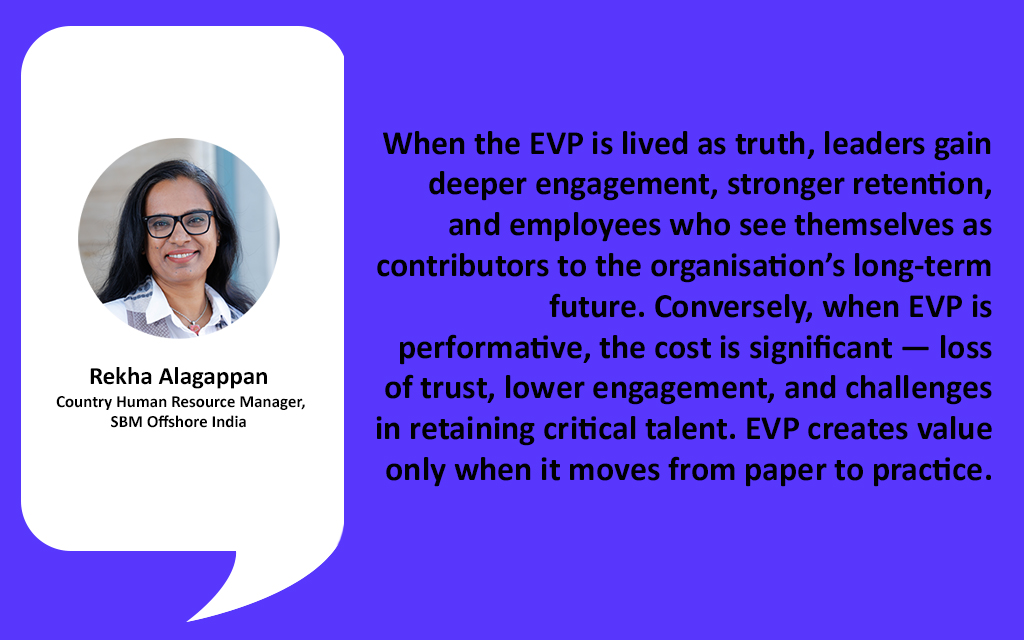
Rekha Alagappan grounds the discussion in operational practice. “Onboarding doesn’t begin on Day One; it starts the moment an offer is accepted.” She speaks of structured induction plans, buddy systems, HRBP check-ins and cross-functional exposure as important scaffolding. Yet she is careful to add that “Even strong EVP commitments lose meaning when experiences are inconsistent.”
For Rekha, the first 90 days are where alignment between corporate EVP and team culture is either strengthened or exposed.
Jaya Virwani emphasises that the earliest months determine whether EVP feels credible or performative. As she explains, “In any large, global organisation, the first 90 days often determine whether an employee sees the employee value proposition as a promise or a lived experience.” New joiners, she notes, are actively looking for signs that culture enables them to bring their full selves to work and that every voice is valued.
Over time, organisations also learn that strong intent is not always enough. She reflects, “While our intent has always been strong, experiences needed to be felt consistently across teams and locations,” which is why practices like intentional All-in moments are embedded into team routines to ensure participation, representation and trust are experienced in everyday interactions.
Bhavna Batra throws light on the fact that the first 90 days are when “curiosity and vulnerability are at their peak.” During this period, the EVP begins to take shape through what she describes as crucial bridge-building, connecting individuals to the workplace, their work context, and the organisation’s culture so that the organisation's promise becomes relatable and real.
Trupti Gandhi maintains that in the first 90 days, new hires quickly evaluate the lived experience behind EVP promises. They watch whether their voice is genuinely heard, whether they are trusted with real ownership and if flexibility is supported without subtle judgement.
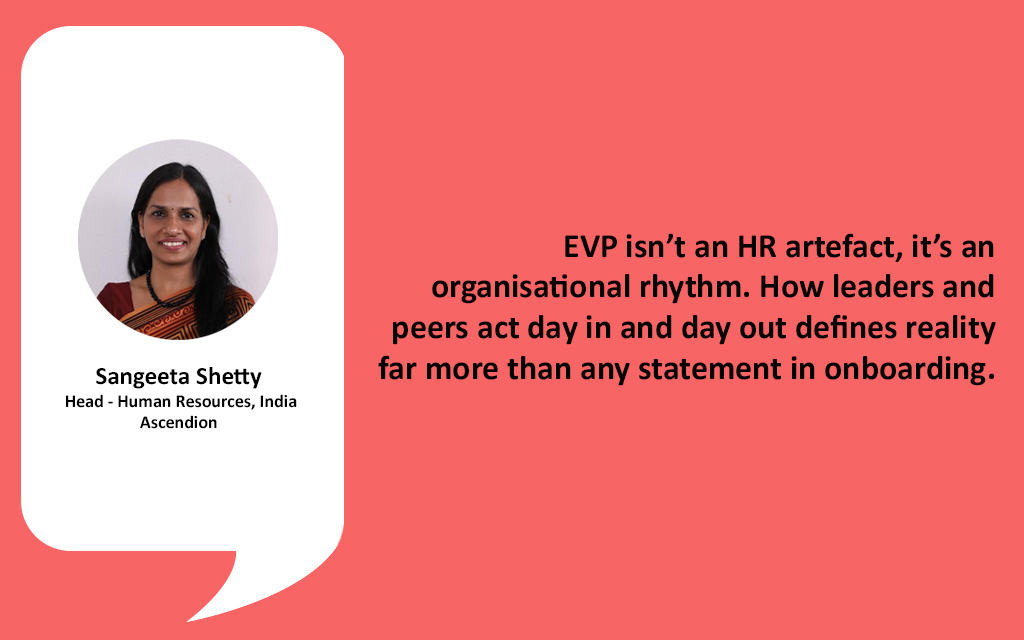
Sangeeta Shetty emphasises that early in their tenure, employees test whether policies matter in practice. Promises around growth, mentorship, inclusion and flexibility are quickly validated or questioned through everyday behaviours. As she puts it, EVP is not an HR artefact but an organisational rhythm shaped by how leaders and peers act every day.
Zoha Kazi notes that in the first 90 days, EVP claims shift from narrative to validation, as new joiners test promises through two primary channels: first, the external employer brand they have consumed through reviews, social content, and networks; and second, the expectations set during hiring by recruiters and interviewers. She adds that areas such as role clarity, decision rights, manager cadence, and the speed of removing friction are closely scrutinised, with gaps often arising from inconsistent execution rather than intent.
Preena returns to the essence. “Gen Z women are incredibly astute at picking up subtle organisational signals.” They are not simply absorbing messaging. They are verifying alignment. They are discerning whether stated values truly translate into daily experience or whether legacy processes create unseen friction.
Across all these voices, the pattern is unmistakable.
The first 90 days are not an adjustment period. They are an assessment window.
In those weeks:
- Flexibility is not promised; it is exercised.
- Growth is not described; it is demonstrated.
- Inclusion is not stated; it is experienced.
- Psychological safety is not assumed; it is tested.
The verdict does not form through surveys. It forms through observation.
And once that early narrative takes shape, it becomes the lens through which every future experience is interpreted.
The Signals Gen Z Women Decode First
Before they fully understand organisational charts or reporting lines, Gen Z women begin interpreting culture.
Neha highlights the signals Gen Z women decode first, noting that they quickly assess “who is actually safe to trust” and whether they can express themselves without fear. They notice who sits at decision-making tables and whose ideas are heard, especially in a landscape where representation drops from 28 per cent at the individual contributor level to about 8 per cent at the CEO level. Just as quickly, they read everyday cues, whether boundaries like logging off on time or taking mental health days are genuinely respected.
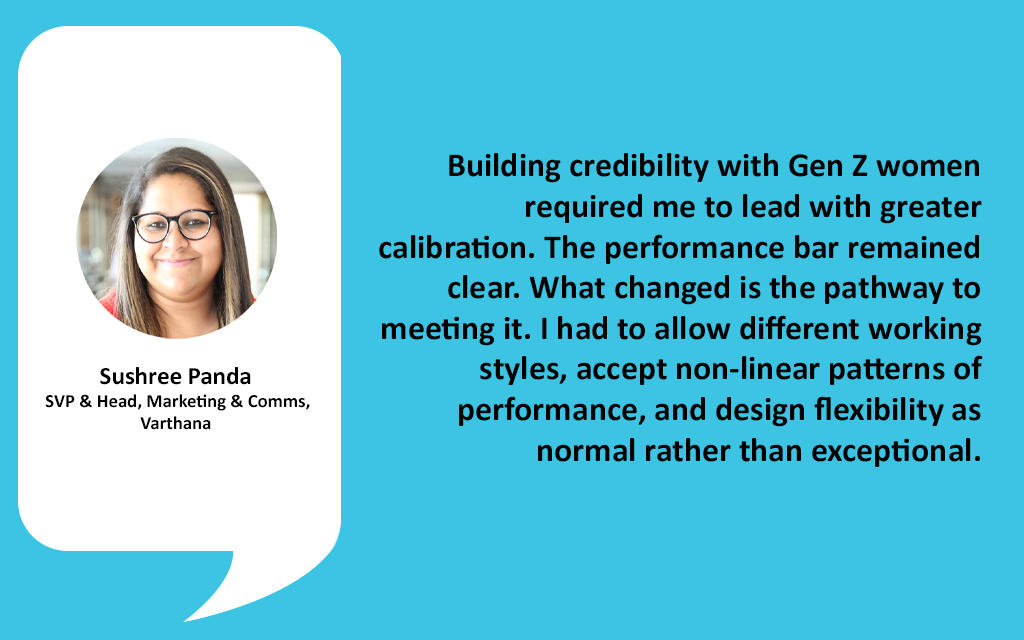
Sushree emphasises that Gen Z women read very early whether fairness is structural. They observe how managers respond when someone pushes back. They notice whose ideas are credited and whose are interrupted. “Culture is not defined by what is said. It is defined by what is consistently done.” If flexibility or wellbeing is subtly penalised in performance discussions, that contradiction is visible early.
She tells us that these early experiences determine whether they operate with clarity or with caution, and how deeply they choose to invest their ambition in the organisation.
Renuka sharpens the lens around psychological safety. “A new hire’s first dissenting opinion reveals far more than any culture presentation.” To deepen this perspective, she adds that the ‘permission to unplug’ reveals whether work–life balance is real or merely rhetoric, often exposed by leadership behaviours and after-hours expectations. When reality contradicts the promise, new hires, especially Gen Z women, begin questioning long-term fit within the first few weeks.
She also speaks about what she calls the aspiration gap. Gen Z women are not only observing the C-suites; they are observing how leadership feels. If senior roles appear synonymous with exhaustion and emotional labour, ambition becomes conflicted. They are highly attuned to gendered emotional labour and everyday signals of equity, judging not just representation but whether the path to leadership appears sustainable or draining.
Sangeeta also echoes this sentiment, noting patterns in who receives psychological safety. They read the culture through everyday interactions, who is invited to speak, how feedback is received and whether questions trigger curiosity or defensiveness, often even before formal onboarding begins.
Echoing the sentiment on psychological safety, Bhavya says that Gen Z women quickly notice signals of inclusion, particularly whether ideas are welcomed, interruptions are minimised, and feedback is respectful. They tend to read micro behaviours around voice, respect and equity far more closely than formal policies.
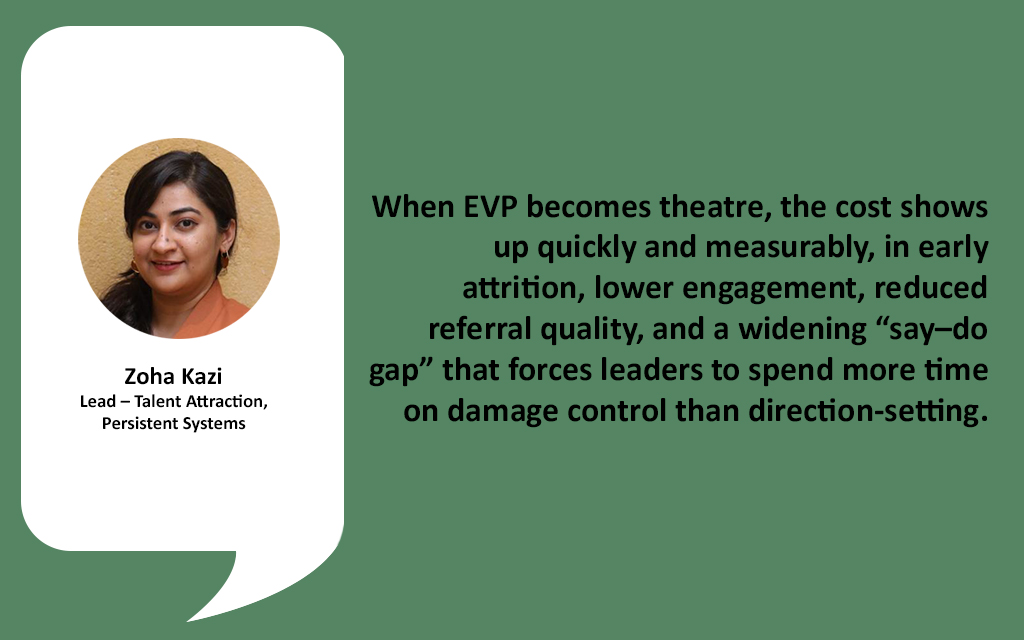
Zoha points to a critical early signal: not the stated flexibility policy, but how flexibility is actually practised. She explains that Gen Z women read cues in how hybrid work is treated, whether boundaries are respected and how managers respond to personal constraints, alongside the everyday tone of psychological safety and inclusion in micro-decisions, quickly distinguishing between EVP messaging and the actual managerial operating system.
Trupti points out that Gen Z women quickly assess whether leaders genuinely value skills over hierarchy or bias. As she explains, “inclusion is not about campaigns or panel discussions; it’s about whether leaders genuinely recognise and support their skills.
She indicates that measured risk and experimentation are welcomed by this generation, but only when there is fairness in evaluation. If expectations are ambiguous, confidence reduces quickly.
Jaya highlights that leaders often underestimate how quickly Gen Z women form a holistic impression of an organisation. They are “exceptionally aware of subtle signals that reveal whether inclusion is truly practised,” observing whether women’s voices, especially those of younger women, are invited, acknowledged and acted upon, or whether meetings are dominated by a few. They also watch for behavioural consistency, whether managers genuinely model psychological safety and whether opportunities like stretch assignments, visibility moments or mentorship are distributed equitably. For Gen Z women, these early signals determine whether they feel safe to contribute authentically and see a future in the organisation.
Rekha brings attention to how quickly Gen Z women read signals around trust, pace and recognition. With strong analytical instincts and comfort with data, they assess whether organisations truly respect individuality, growth and balance, or whether those ideals remain aspirational.
Bhavna points to communication as one of the first signals Gen Z colleagues decode, not just what is said, but “how it is said and what is not said or left vague.” She also notes their pragmatic view of work as one part of life, which makes cues around flexibility, lived culture and real-time belonging visible much earlier.
Preena encapsulates the collective observation:
“Building credibility with this generation requires a conscious shift in leadership; we must be willing to cede a degree of traditional control and attachment to legacy processes, fostering psychological safety and fostering an environment of trust and co-creation.”
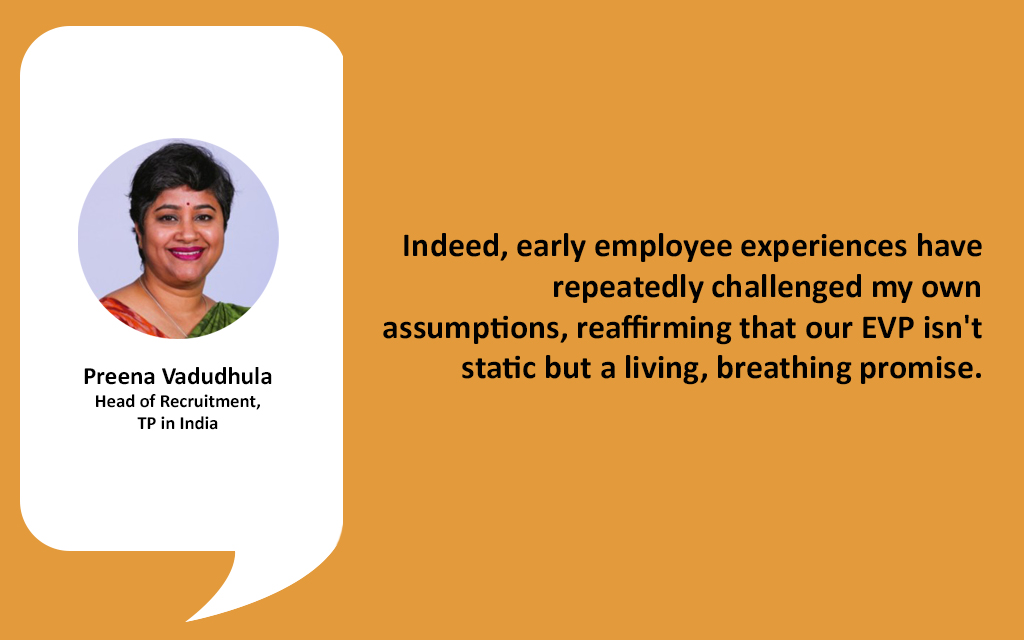
She shares that early employee experiences have repeatedly challenged her own assumptions, reinforcing that EVP isn’t static but rather a living, breathing promise.
Across all these voices, the conclusion is unmistakable.
Gen Z women decode:
- Whether inclusion is structural or symbolic
- Whether flexibility is protected or precarious
- Whether leadership is aspirational or unsustainable
- Whether feedback is developmental or defensive
They are not absorbing EVP passively. They are testing coherence.
And they do so quickly.
The signals are rarely dramatic. They are embedded in tone, in meeting dynamics, in the way disagreement is handled, in how credit is assigned, and in how transparency is practised.
By the time formal engagement surveys capture sentiment, much of the narrative has already been formed.
Trust has either deepened.
Or it has become conditional.
Ink Dive: What is the #1 Policy Women Want at Workplaces?
What Leaders Have Had to Consciously Give
The theme of Give to Gain becomes most tangible in what leaders admit they have relinquished.
Renuka speaks candidly about letting go of what she calls the ‘pedigree of presence’. Leadership, she reflects, was once built on the idea that visibility equals productivity, endurance and control. Yet with Gen Z women, authority built on hierarchy does not automatically translate into credibility. She recalls moments when younger colleagues proposed automating or redesigning processes she had spent years refining. The shift required humility. Impact, not ownership of legacy systems, had to take precedence.
She advocates that credibility today belongs to leaders who are willing to unlearn publicly.
Bhavna chaperones the above sentiment by adding that, “Credibility with Gen Z colleagues is about walking the talk consistently.” She adds that Gen Z women often bring an assured sense of self, making it important for leaders to create space for ideas, remain fair and accessible, while also holding them accountable for meaningful outcomes.
Neha asserts that leaders must consciously give, saying she had to let go of “the comfort of control and the illusion of certainty.” Instead, she emphasises asking rather than assuming and co-creating culture with Gen Z women rather than expecting them to accept it.
She also articulates on reviewing performance frameworks that equate contribution strictly with ratings or output. In engaging Gen Z women, she has had to question whether traditional metrics truly capture evolving skills, mindset and growth. Letting go of rigid evaluation templates has been part of building credibility.

Sushree shares that early in her leadership journey, she equated fairness with uniformity. The same rules applied equally. Over time, feedback from younger employees made her reconsider that stance. Equity requires context. “Instead of asking whether something would be acceptable to me, I began asking what it meant for the individual concerned.” The performance bar remained high, but the pathways toward it required flexibility.
She also acknowledges the need to give up assumptions around access equating to utilisation. Simply making policies available was not enough. Leaders and managers need to model usage and normalise conversations. She remarks, “Availability opens the door, but behaviour determines whether people walk through it”.
Rekha points out that moving away from top-down certainty has been essential. Involving younger employees earlier in decision-making, trusting them with problem-solving responsibility and being transparent about evolving processes required surrendering some degree of control.
Jaya admits that building credibility with Gen Z women has required leaders to consciously give two things: the strength of legacy processes and greater control over how employees shape their experience of work. Legacy processes provide stability and fairness amid uncertainty, while giving employees more control over wellbeing, work preferences and career pathways signals trust and reinforces that their voice has real weight in how the organisation evolves.
Zoha reflects that building credibility with Gen Z women requires moving away from legacy assumptions like “if it cannot be seen, it is not happening,” and instead focusing on clarity of outcomes, decision rights and feedback. It also means embracing co-creation and simplifying processes to reduce friction and build trust faster.
Trupti acknowledges that leaders must move away from micromanagement and let go of the “this is how we have always done it” mindset. As she notes, “credibility today comes from adaptability, not position,” replacing control with coaching and hierarchy with collaboration.
Sangeeta stresses that credibility today requires leaders to “relinquish control and embrace co-creation.” For Gen Z women, she explains, trust grows through transparency, shared problem-solving and giving employees real choice rather than relying on hierarchy or rigid processes.
“Gen Z women value autonomy, transparency, and flexibility, so we need to minimise control. I focus on clear outcomes and let them shape the path,” adds Bhavya.
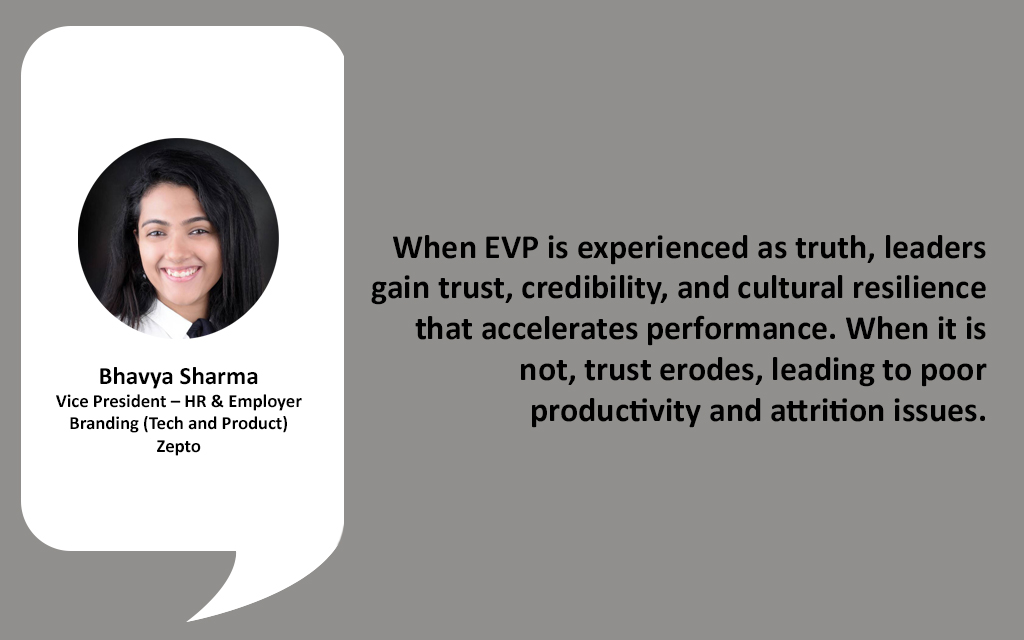
Across these perspectives, the pattern is clear.
What leaders have had to consciously give includes:
- Absolute control over the process
- Attachment to legacy systems
- Standardised interpretations of fairness
- The comfort of unquestioned authority
- The assumption that policy equals practice
In return, they gain something less visible but far more durable.
—Credibility.
And in the context of Gen Z women navigating their first months within an organisation, credibility is not granted by title.
It is earned through visible evolution.
When Early Experiences Force a Rethink
Several leaders acknowledge that early employee feedback unsettled comfortable assumptions.
Sushree believed that access would translate into usage. Whether it was wellbeing support or development programmes, availability seemed sufficient. Yet workplace data revealed a different story. While most organisations offer wellbeing support, utilisation of employee assistance programmes often sits between 3 and 10 per cent.
Early employee experiences reflected this gap. New joiners, particularly Gen Z women, were not evaluating what existed on paper. They were assessing whether it was safe to use without it influencing perception, performance, or growth. Access without psychological safety rarely translates into utilisation.
Zoha suggests that early experience data often challenges assumptions around key EVP differentiators. As she points out, “access to platforms and training catalogues is often assumed to equal development,” yet new joiners judge growth through meaningful work, feedback and mobility, making it critical to treat EVP as a product with clear indicators to catch gaps early.
Neha realised that feedback challenged common assumptions, including the belief that strong policies automatically create good experiences. Despite progressive benefits, women still form only about 26 per cent of the workforce, pushing leaders to shift from “EVP as promise” to “EVP as practice.”
Renuka recounts a defining conversation with a Gen Z engineer who declined a managerial path, saying, “I want my impact measured by the problems I solve, not the number of meetings I attend.” Growth, she realised, is skill elasticity and autonomy. Organisations must build expert tracks that enable them to grow deep, instead of just up.

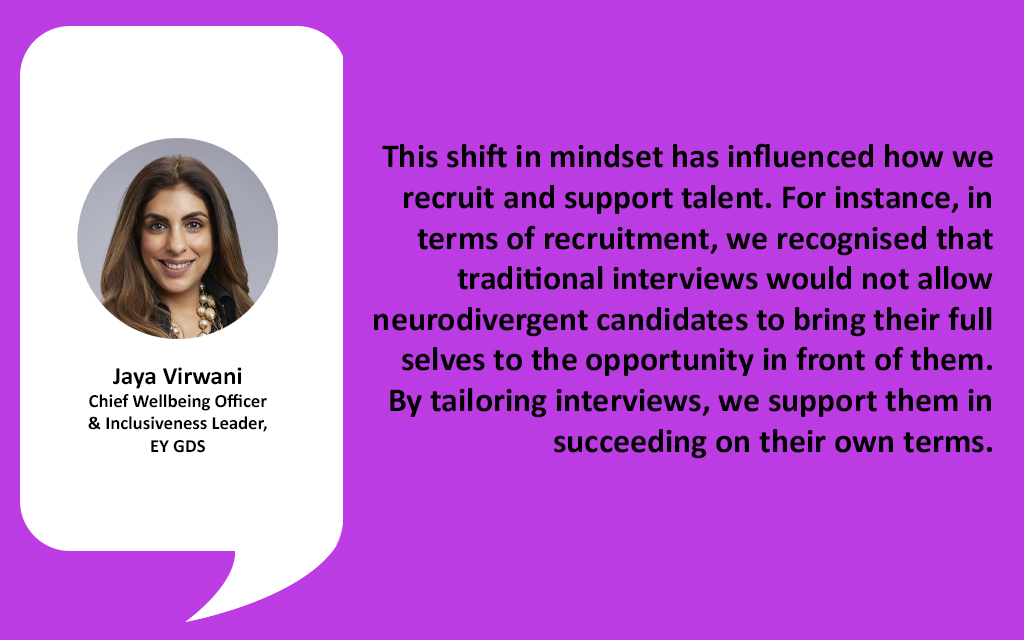
Jaya signals that early employee experiences revealed that people do not begin their careers from the same starting point, prompting a shift in how organisations design their EVP. Instead of assuming one set of practices serves everyone equally, she emphasises the need for intentional design, whether by tailoring interviews so neurodivergent candidates can succeed on their own terms or by making structural choices that signal belonging, such as equal benefits for same-sex and heterosexual partners.
Rekha shares that siloed delivery of EVP elements created fragmented experiences. Employee input drove a shift toward unified alignment with local nuance. She talks about the shift “towards a more unified, globally aligned EVP framework with consistent messaging, while still allowing for local nuance.”
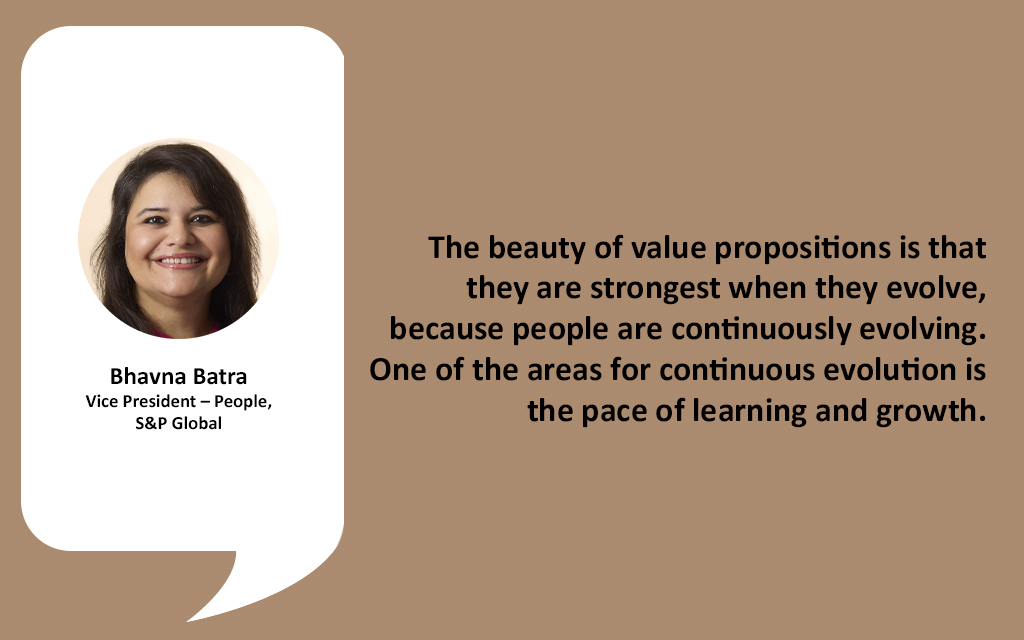
Bhavna expresses that value propositions are strongest when they evolve because people themselves are constantly evolving. She points to the shift toward a pull-based learning ecosystem, where employees can choose from a wide menu of development options such as career coaching, technology and power skills modules, persona-based learning paths and discussion-led learning circles.
Trupti adds that EVP is not defined only at the organisational level but is ultimately experienced at the manager and team level.
Sangeeta shares that early experience revealed how essential clarity is. Opportunity without clear expectations, visibility into decision pathways and consistent feedback can feel ambiguous and erode trust. This prompted a recalibration in how progression and success are communicated so that promise and experience align.
Assessing these reflections, early experiences force leaders to rethink:
- Access without psychological safety
- Policy strength without lived practice
- Growth is defined only through hierarchy
- One-size EVP design
- Siloed delivery of culture
- Opportunity without clarity
Early experience, in other words, becomes the organisation’s most honest feedback loop.
Truth, Theatre and the Cost of Getting It Wrong
When EVP is experienced as truth, the return on investment extends far beyond retention dashboards.
Preena articulates the stakes clearly: “When EVP is experienced as truth rather than theatre, we gain an unparalleled ability to attract, retain and inspire diverse talent. The cost of failing to live that truth is immediate: erosion of trust, talent and strategic capacity to lead in an AI-driven world.”
That erosion rarely begins loudly.
Neha Chopra observes that when EVP is experienced as truth, leaders gain something branding cannot buy: trust. In genuinely inclusive workplaces, employees show stronger intent to stay and perform, with women reporting an 8-point better experience on fairness and benefits.
Sushree reframes EVP as an operational discipline rather than a branding exercise. Alignment between what is said and what is practised strengthens leadership authority. Misalignment does not merely disappoint; it weakens managerial legitimacy. When early promises around growth or flexibility feel overstated, employees do not necessarily protest. They adjust their ambition.
Renuka calls attention to what she describes as silent exits. High-potential women rarely leave dramatically. They disengage intellectually first. They stop volunteering ideas. They narrow their risk appetite. They become careful rather than bold. By the time attrition becomes visible, belief has already faded.

Trupti adds a sectoral dimension. In high-growth environments, adaptability is everything. When Gen Z women trust the system, they experiment, innovate and accelerate transformation. When they doubt fairness or transparency, they conserve energy. The organisation loses momentum precisely when it most needs agility.
Interestingly, Trupti talks about how EVP is experienced as truth rather than theatre. It helps leaders to gain trust, commitment and ownership from employees. When it does not match reality, the cost appears as silent disengagement, reduced motivation and loss of trust that is far harder to rebuild than to promise.
Bhavya observes that when EVP is experienced as truth, leaders gain trust, credibility and cultural resilience that accelerates performance. When it is not, trust erodes, often leading to lower productivity and attrition.
Zoha explains that when EVP is experienced as truth, leaders gain discretionary effort, faster ramp-up, stronger retention and credible advocacy, as trust allows teams to focus on outcomes rather than navigating ambiguity. When it becomes theatre, the cost is immediate, showing up in early attrition, lower engagement and a widening “say–do gap,” with long-term impact on trust that is far harder to rebuild.
Bhavna evaluates that nurturing relatability and commitment through a genuine sense of belonging is central to a well-lived EVP. Being people-forward while sustaining a high-performance culture creates the balance that enables employees to thrive and contribute meaningfully to enterprise ecosystems that consistently create value for customers and communities.
Sangeeta wants leaders to earn trust that strengthens engagement and long-term contribution. That’s how EVP is genuinely lived. But when it becomes performative, the cost is steep. As she puts it, “When EVP feels theatrical, interesting in theory but absent in day-to-day reality, the result is disengagement and faster attrition.”
As Jaya notes, when EVP becomes theatre, employees quickly notice inconsistencies in everyday behaviours, and trust erodes rapidly. But when it is experienced as truth, inclusion, equity, wellbeing and growth are felt as lived realities rather than messages.
As she puts it, leaders then gain teams that “speak up early, flag risks sooner, innovate more boldly and contribute with a sense of ownership.”
Rekha, too, brings the focus back to lived experience. When EVP moves from paper to practice, leaders gain more than retention. They gain discretionary effort. They gain advocacy. They gain resilience during periods of organisational stress. Employees who believe the promise are more likely to extend grace when challenges arise.
What becomes clear across all voices is this: the cost of theatre is cumulative.
It appears as:
- Reduced aspiration among early-career women
- Hesitation in taking on stretch assignments
- Lower participation in innovation forums
- Increased emotional fatigue
- Gradual erosion of psychological safety
And eventually,
- Measurable attrition.
Conversely, when EVP is experienced as truth, the gain compounds.
Trust strengthens feedback loops. Honest conversations surface earlier. Career pathways evolve faster. Leaders receive sharper insight into systemic friction. Innovation becomes less performative and more embedded.
In that sense, EVP truth is not simply about retention. It is about organisational velocity.
Gen Z women, in particular, are not asking for perfection. They are asking for coherence. If flexibility is promised, it must be modelled. If growth is advertised, pathways must be visible. If inclusion is articulated, power must be shared.
The first 90 days determine whether those elements feel integrated or theatrical.
And once theatre is detected, rebuilding credibility requires far more than revised messaging. It demands structural correction, behavioural consistency and sustained transparency.
The leaders in this feature do not speak of EVP as a marketing narrative. They speak of it as a leadership test.
Because in today’s workforce, especially among Gen Z women, the truth is not inferred from statements.
It is inferred from systems.
And systems, unlike slogans, are difficult to disguise.
Epilogue
A few months in, her days feel lighter.
She speaks without calculating the risk.
She logs off without apology.
She asks questions without softening them first.
Her manager checks in and listens.
Her ideas travel further than the room they were spoken in.
She is not ‘performing’ confidence. She is ‘practising’ it.
Nothing extraordinary has happened.
And that is exactly why she stays.
Because when a promise is kept, it does not feel like policy.
She smiles.
It feels like belonging.