

I have recently started reflecting on how the traditional playbook for ‘employer branding’ has fundamentally shifted. For most of my career, branding was an act of curation. We, as HR leaders, were the architects of a carefully managed window. We picked the best stock photos, scripted the testimonials, and distilled complex cultures into three-word slogans. We owned the narrative because we owned the glass.
But in 2026, that window has been replaced by a mirror, and a two-way one at that. I often call Gen Z the ‘most honest generation’ because they have a fundamentally low tolerance for corporate theatre. They can spot 'slides and slogans' that don’t match their lived reality from a mile away. For them, authenticity is not a corporate buzzword; it is the baseline expectation from leaders, brands, and workplaces alike. When I say they are the most honest, I mean they are more likely to say the uncomfortable but necessary truths out loud, whether it’s about toxic culture, unsustainable workloads, or leadership gaps that others might quietly ignore.
As I observe the current talent shifts across India, where Gen Z now accounts for roughly 27% of our global professional workforce, it's clear that we aren't just dealing with a 'new demographic'. We are dealing with truth detectors who have arrived with a forensic mindset. They are the first generation to treat an Employee Value Proposition (EVP) not as a promise, but as an audit.
The Death of the Curated Narrative
Gen Z grew up in a world where everything is a claim until it's verified. They have watched algorithmic transparency deconstruct everything from skincare brands to political campaigns. Why should their workplace be any different?
When a company in India claims to offer work-life balance, Gen Z professionals do not take the recruiter’s word at face value. They go decentralised, scouring Reddit threads for the "real" take on a manager's weekend email habits or DM-ing mid-level employees on LinkedIn to ask if the flexible policy is actually a career-killer.
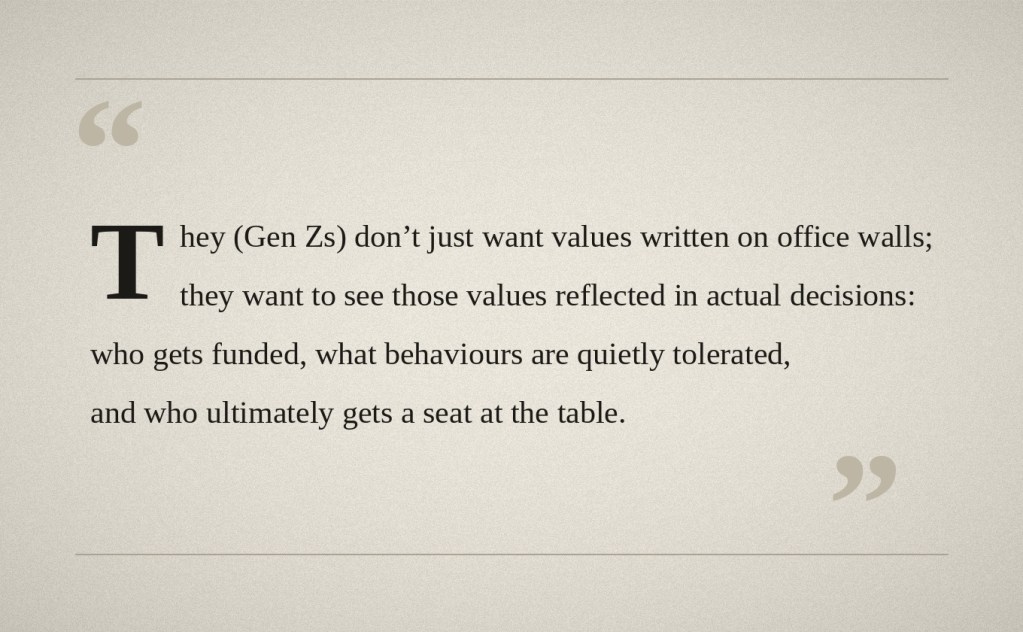
In their eyes, the official company website is just the marketing layer. The truth resides in the metadata of daily operations. If there is even a 10% discrepancy between what we say and what they see on Glassdoor, the trust is gone before the first interview. They don’t just want values written on office walls; they want to see those values reflected in actual decisions: who gets funded, what behaviours are quietly tolerated, and who ultimately gets a seat at the table.
Ink Dive: If You Cannot Enable Movement, Talent Will Move: Varun Gautam on Retention at Persistent Systems
The Inclusion Audit: Who is Actually in the Room?
We often talk about Equity, Diversity, and Inclusion (EDI) as a brand pillar. But for Gen Z, inclusion isn't a sentiment; it's an outcome of organisational justice. They are looking past Diversity Month posts and straight into our promotion cycles.
When our EVP says 'we are an inclusive workplace,' they are immediately running a mental audit: Who is actually getting promoted in this firm? Does the leadership reflect the diversity of the Tier-2 and Tier-3 talent we are hiring?. They have seen enough performative allyship to recognise it on sight. To win them over, our branding has to stop being about values and start being about accountability. If we claim to be inclusive but our senior leadership remains a demographic monolith, Gen Z doesn't see a stable company; they see a ceiling.
The Glass Box and the AI Moral Contract
We once operated in Black Boxes, where what happened inside the office stayed inside. We are now Glass Box organisations, in which every internal decision is potentially public. This transparency is critical as AI reshapes the Indian employment landscape.
Gen Z is watching how we integrate these tools. In my view, they have a remarkably clear mental map of this transition: they recognise that AI is brilliant at speed, scale, and pattern recognition, but humans remain superior in context, ethics, empathy, and judgment. They are not asking us to choose between tech and people; they are asking us to design for AI–human coupling. Their expectation from leadership is simple: Let the machine do the boring, let the human do the meaningful. For them, a truthful employer brand in 2026 is honest about the tech-human hybrid. An authentic brand doesn't promise job security (which they know is a myth), it promises employability.

From Career Ladders to Portfolio Building
The traditional Indian corporate dream was the linear ladder: you put in the time, you climbed the steps. But Gen Z has seen that ladder break too many times through layoffs and economic volatility. They are not looking for a ladder anymore; they are looking for a jungle gym of skills.
I often hear colleagues misinterpret Gen Z’s work ethic, labelling them as allergic to hard work. I see the exact opposite. They are not resistant to hard work; they are resistant to work that lacks meaning. They refuse to glorify 12–14‑hour days as a badge of honour if those hours are merely filled with low‑value tasks, office politics, or performative busyness. They are effectively challenging our long-standing obsession with visibility over value, and the culture of looking good rather than being good.
If our branding promises growth, but our internal reality is a rigid system that rewards time spent over impact made, they will detect the lie and move on.
The C-Suite as Stewards, Not Spokespeople
This shift requires a fundamental change in how we, as leaders, show up. In the past, the CHRO's job was to protect the brand. Today, our job is also to ensure the truth.
Gen Z values vulnerability over polish. They would rather hear a CEO admit to struggling with a gender pay gap while outlining a fix than hear a generic 'we value equality' statement. In 2026, admitting imperfection is not a weakness, but rather a radical act of credible leadership. Every generation has challenged the status quo, but Gen Z is forcing us to confront questions we have long postponed: Why do we still do it this way? What should humans stop doing because AI can? What is the real value of this role?
Final Thoughts: The Future Rewards What is Real
The 'Truth Detector' generation isn't making our jobs harder; they are making our organisations better. They are forcing us to close the gap between the story we tell and the reality we provide.
If we listen, Gen Z can help us build workplaces that are more honest, more humane, and more intelligent—not just for them, but for every generation. The real risk we face is not that Gen Z will change everything; the risk is that we will cling to outdated norms and lose them, along with the vital evolution they are trying to trigger.
The era of the glossy brochure is over. In a world where every employee is a potential micro-influencer and every corporate pivot is scrutinised, the only sustainable branding strategy is radical authenticity. In the end, Gen Z is not looking for the perfect company; they are looking for a real one. As we look toward the future of the Indian workplace, the defining edge for organisations will be the unshakeable consistency of their character because in this new landscape, the most resilient brands are the ones with nothing to hide.
Anjali Raghuvanshi is the Chief People Officer at Randstad India and GCC. An MBA from ICFAI Business School Hyderabad, she also has a flair for finance, having earned an honours degree in finance from Banaras Hindu University. A strategic business partner, she facilitates, supports and challenges business leaders while anticipating shifts in workplace dynamics within an evolving business landscape. Her experience spans industries such as IT, automotive, and consulting, with a strong focus on talent management, a performance-driven culture, and organisational transformation. She is also passionate about sustainability, inclusive workplaces, and the development of future talent through campus engagement.