

Artificial Intelligence is rapidly reshaping how organisations think about productivity, workforce planning, talent deployment, and operational efficiency. Across industries, leaders are embracing AI to improve decision-making, unlock efficiencies, and gain greater visibility into increasingly complex operations.
In aviation services, the opportunity is particularly significant — especially in ground handling, which serves as the backbone of the entire aviation ecosystem. From timely aircraft turnarounds to seamless cargo movements, from world-class passenger facilitation to safety compliance, ground handling underpins every airport touchpoint. As ground operations grow more complex and time-sensitive, integrating AI into ground-handling processes can unlock transformative gains in precision, coordination, and reliability — enhancing not just efficiency but also the overall integrity of aviation services.
Every day, ground handlers make thousands of time-critical decisions to ensure safe, efficient, and on-time departures and arrivals at airports across the world. Workforce deployment, turnaround coordination, baggage and cargo handling, equipment utilisation, passenger services, and compliance must align seamlessly within tight timelines. AI is transforming this complexity by enabling predictive workforce planning, real-time operational visibility, and faster, data-driven decision-making.
However, as organisations accelerate AI adoption, an important truth deserves equal attention: while AI can improve operational intelligence, it cannot replace operational judgement. In industries such as aviation, that distinction is critical.

AI as an Operational Co-pilot
The conversation around AI is often framed in terms of automation. In reality, its immediate value lies in augmentation.
AI is enabling a shift from reactive decision-making to predictive planning. Workforce requirements can be forecast more accurately. Resource allocation can be dynamically optimised. Potential bottlenecks can be identified before they escalate into disruptions.
According to The Future of Jobs Report - 2025, technological change continues to reshape the global workforce, with nearly 39 per cent of existing skills expected to evolve or become outdated by 2030. The report also highlights that 85 per cent of employers plan to prioritise workforce upskilling. For operationally intensive industries, these shifts are already visible.
AI-driven systems can analyse large volumes of operational data in real time, enabling more accurate forecasting of passenger flows, manpower requirements, equipment utilisation, and service demand. This enhances planning efficiency while improving responsiveness to changing conditions.
Air India SATS’ Ground Radar is a compelling example of how AI-driven predictive analytics can transform ground handling operations. By analysing historical flight patterns, real-time operational data, and demand variability, Ground Radar enables the intelligent allocation of both manpower and ground support equipment (GSE) with a high degree of precision. This ensures that resources are optimally deployed ahead of each aircraft movement, reducing idle time while preventing last-minute shortages.
In an environment where turnaround efficiency is critical, such predictive capability enhances coordination across teams, improves on-time performance, and strengthens operational reliability. Importantly, it demonstrates how AI further elevates ground handling as a data-led enabler of seamless airport services.
Ink Dive: Why Duraisamy Rajan Palani Believes AI Will Reward Smaller, Smarter Teams
Yet even with these advancements, operational reality remains inherently unpredictable.
In aviation, where even minor disruptions can ripple across multiple stakeholders, predictive capabilities are essential, but not sufficient. No two days are the same. Weather disruptions emerge without warning, schedules change, aircraft are reassigned, equipment availability fluctuates, and customer requirements evolve in real time. Regulatory and safety considerations can introduce sudden, non-negotiable complexity.
In this environment, AI offers critical support. It can identify patterns, flag risks, and recommend actions with speed and precision. But it cannot take ownership in high-pressure, time-critical scenarios. Aircraft turnarounds cannot pause for ideal solutions, and disruptions cannot always be resolved through models alone. Plans often need to be recalibrated repeatedly within short windows as situations evolve.
This is where human judgement remains indispensable. Experienced operational leaders bring context that data alone cannot capture—understanding local realities, stakeholder expectations, workforce dynamics, and the nuances of on-ground execution. Their ability to interpret, adapt, and act decisively ensures resilience when operations become unpredictable.
Equally critical in aviation is the role of training. The industry is built on rigorous, scenario-based preparation that equips teams to respond decisively in high-pressure environments. This training develops not just technical proficiency, but judgement, discipline, and accountability. While AI can enhance situational awareness, it cannot replicate the instinct and confidence built through experience. In practice, the most effective operations are those where technology strengthens, rather than substitutes, skilled human capability.
By taking on routine tasks, AI further enables frontline teams to focus on precision, coordination, and customer engagement, ensuring that professionalism and the human touch remain the defining differentiators across the passenger and cargo journey.

Balancing Efficiency With Human Context
As AI capabilities advance, organisations face a new leadership challenge: balancing efficiency with human context.
Data is powerful, but incomplete without context. A workforce deployment model may identify the most efficient allocation of resources based on productivity metrics. Yet operational effectiveness often depends on factors that are difficult to quantify—experience, adaptability, situational awareness, team dynamics, local expertise, and the ability to perform under pressure.
In aviation operations, these factors directly influence outcomes. The risk lies in assuming that optimisation automatically leads to resilience.
This becomes even more relevant as organisations increasingly rely on AI-driven talent decisions, workforce analytics, and productivity measurement. Leadership teams must ensure that the pursuit of efficiency does not come at the cost of judgement, trust, or human capability.
At the same time, the human side of AI adoption cannot be overlooked. Across industries, employees continue to grapple with fundamental questions—how roles will evolve, which skills will remain relevant, and what employability looks like in an increasingly automated environment.
A global workplace study by Workday found that 80 per cent of employees believe their organisations lack clear guidelines around AI adoption. This uncertainty often creates more anxiety than the technology itself. Similarly, research highlighted by Nexthink suggests that many organisations are adopting AI faster than they are preparing employees to work alongside it.
This makes leadership essential. Successful AI transformation is not simply about implementing technology; it is about building trust. Clear communication, investment in capability development, and a commitment to workforce readiness are critical to ensuring that employees feel equipped to navigate change.
Why Human Durability Will Be a Competitive Advantage
As AI automates routine tasks, the value of uniquely human capabilities will continue to rise. The World Economic Forum identifies resilience, analytical thinking, leadership, adaptability, creativity, and lifelong learning among the fastest-growing workforce skills — particularly in operational environments.
In aviation, success often depends on the ability to perform in conditions where variables shift rapidly, and decisions must be made under pressure. Increasingly, organisations must invest in what can be described as human durability—the ability to remain effective amid uncertainty.
Human durability reflects the capacity to adapt as situations evolve, the confidence to make decisions under pressure, and the judgement to recognise when experience should override a system-generated recommendation. These are not merely soft skills; they are business-critical capabilities.
The Future CHRO as a Transformation Architect
The AI era is also reshaping leadership itself.
Historically, technology transformation and people strategy operated as separate domains. That separation is no longer sustainable. Business leaders must better understand workforce implications, while HR leaders must engage more deeply with operations and technology adoption.
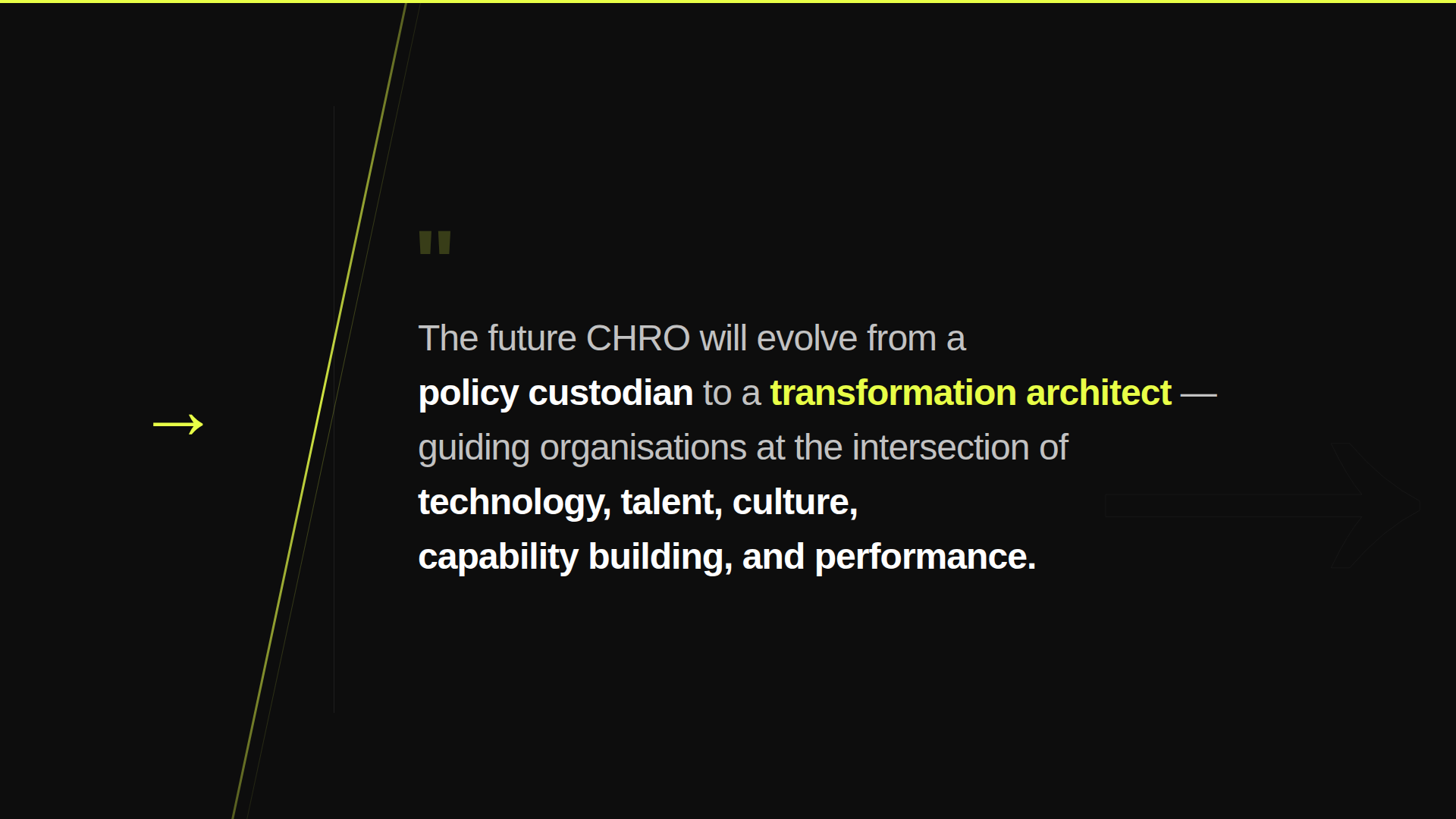
The future CHRO will evolve from a policy custodian to a transformation architect — guiding organisations at the intersection of technology, talent, culture, capability building, and performance. The organisations that succeed will not necessarily be those deploying the most AI tools, but those aligning technological advancement with workforce readiness.
Technology May Guide Operations, People Will Define Outcomes
Aviation has always evolved alongside technology, from automated systems to real-time operational monitoring and predictive analytics. Each advancement has improved efficiency, safety, and customer experience.
AI represents the next phase of this evolution. Its ability to enhance planning, forecasting, and visibility is undeniable. Organisations that fail to embrace it risk falling behind.
Yet every advancement in aviation reinforces a fundamental reality: technology performs best when paired with capable people.
When disruptions emerge, conditions shift unpredictably, and critical decisions must be made under pressure, human judgement remains irreplaceable. AI may predict delays, identify risks, and recommend actions, but it takes skilled professionals to interpret context, exercise judgement, coordinate responses, and ensure safe, efficient operations.
The future of aviation will not be defined by how much AI we deploy. It will be defined by how effectively we combine intelligent technology with human expertise, trust, and leadership.
Because behind every successful turnaround, every seamless passenger experience, and every on-time departure, people still make the difference.
Namit Baikar is the Chief Human Resources Officer at AISATS, bringing over 19 years of cross-industry experience spanning aviation, logistics, retail, and manufacturing across the Asia Pacific and Middle East regions. Over the course of his career, he has led strategic initiatives in people transformation, operational excellence, employer branding, leadership development, and workforce capability building with organisations including SATS Ltd., IKEA, and Maersk. A certified leadership coach and Six Sigma Green Belt holder, Namit is also an active industry speaker and mentor, known for bringing a deeply operational and human-centric perspective to leadership and talent strategy.