

Healthcare is fundamentally about caring for people. Yet today, the quality of care often suffers because healthcare professionals are overwhelmed by data-intensive and repetitive tasks. Their day-to-day work is highly stressful, unpredictable, and often chaotic, making mistakes more likely. I have witnessed the pressure this creates for professionals and the downstream impact it has on everyone involved.
While it is tempting to assume that such work is vulnerable to AI disruption, particularly when it is labelled as ‘error-prone’ and ‘repetitive’, the reality is far more nuanced.
New AI systems will support our teams by taking over monotonous and data-intensive tasks, but they cannot and should not replace the heart of our hospitals or make critical medical decisions. AI should be viewed as a tool for handling paperwork, identifying patterns in medical scans and reports, or accelerating lab processes. This allows healthcare staff to focus more on patient care while also reducing the likelihood of human error.
In many ways, AI can improve the speed and consistency of healthcare operations. It can help radiologists analyse scans more efficiently, assist nurses with administrative workflows, and support hospital teams in managing large volumes of patient information. However, interpretation, accountability, and patient trust remain deeply human responsibilities. The effectiveness of AI in healthcare will ultimately depend on how successfully it complements clinical expertise rather than competes with it.
AI is not here to replace healthcare professionals or make independent medical or administrative judgements. Its true value lies in augmenting the workforce, not replacing it.
Experienced Human Judgement is Irreplaceable
The real value of medical data depends on how effectively we use it. Even as technology advances, human judgement remains the most critical component of healthcare. AI cannot fully understand the contextual nuances that trained and experienced medical professionals intuitively recognise. Social, economic, and psychological factors that influence a patient’s health, recovery, care, and risk of relapse can easily be overlooked by AI.
Doctors are trained to go beyond the information presented to them and assess patients holistically to identify missing or withheld details. AI, however, can be misled by incomplete or inaccurate information, potentially resulting in incorrect diagnoses.

Helping Workers, Not Directing Them
Healthcare decisions often involve life-and-death situations. AI systems cannot understand a patient’s emotions or personal circumstances and therefore cannot make ethical decisions or replace clinical judgement. AI must remain a supportive tool, not an authority that makes final decisions. Leaders must ensure that AI-driven workflows and agentic systems empower healthcare professionals rather than direct them, ensuring that human experts remain accountable for critical decisions.
Ink Dive: ‘The Soul Of The Insight Still Matters’: Neha Arur On Human Judgement In The AI Era At ZS
Preparing for the Future
AI systems have evolved rapidly within a very short period of time, and introducing them into the workplace can be overwhelming for employees. To help teams navigate these changes, organisations must foster a culture that feels both safe and future-ready. This requires moving beyond traditional training methods and helping employees build confidence in emerging digital skills at every level of the organisation.
Understanding data, along with the capabilities and limitations of AI, is becoming a fundamental skill. These capabilities enable teams to evaluate AI outputs critically and solve real-world challenges for patients more effectively.

Making Change Normal and Easy
It is natural for employees to worry that technology may eventually replace their jobs. To address these concerns, leaders must do more than reassure their teams. Organisations need to make change a normal, continuous part of everyday work so it feels less intimidating. Investing in employee learning is ultimately an investment in their future, ensuring that deep medical expertise evolves alongside technological advancement.
Like previous disruptive innovations such as computers, the internet, and smartphones, AI will eventually settle into a complementary and enabling role across healthcare, from front-desk staff to doctors, nurses, lab specialists, and administrators. This will lead to faster processing of reports and results, more accurate diagnoses, and improved recovery and palliative care for patients.
Leaders as Guides for Growth
Executive teams must act as guides, helping their organisations navigate these transitions effectively. Hiring and upskilling strategies must align closely with technology roadmaps to safeguard employee well-being. This also means establishing fair and transparent AI governance frameworks while fostering a shared sense of purpose across teams.
Organisations must cultivate a culture where AI is viewed as a collaborative partner rather than a competitor. As always, culture is shaped from the top. Leaders must also recognise that, as efficiency scales with AI, so too can mistakes and errors in judgement if systems are not managed responsibly.
Getting Back to the Human Side of Medicine
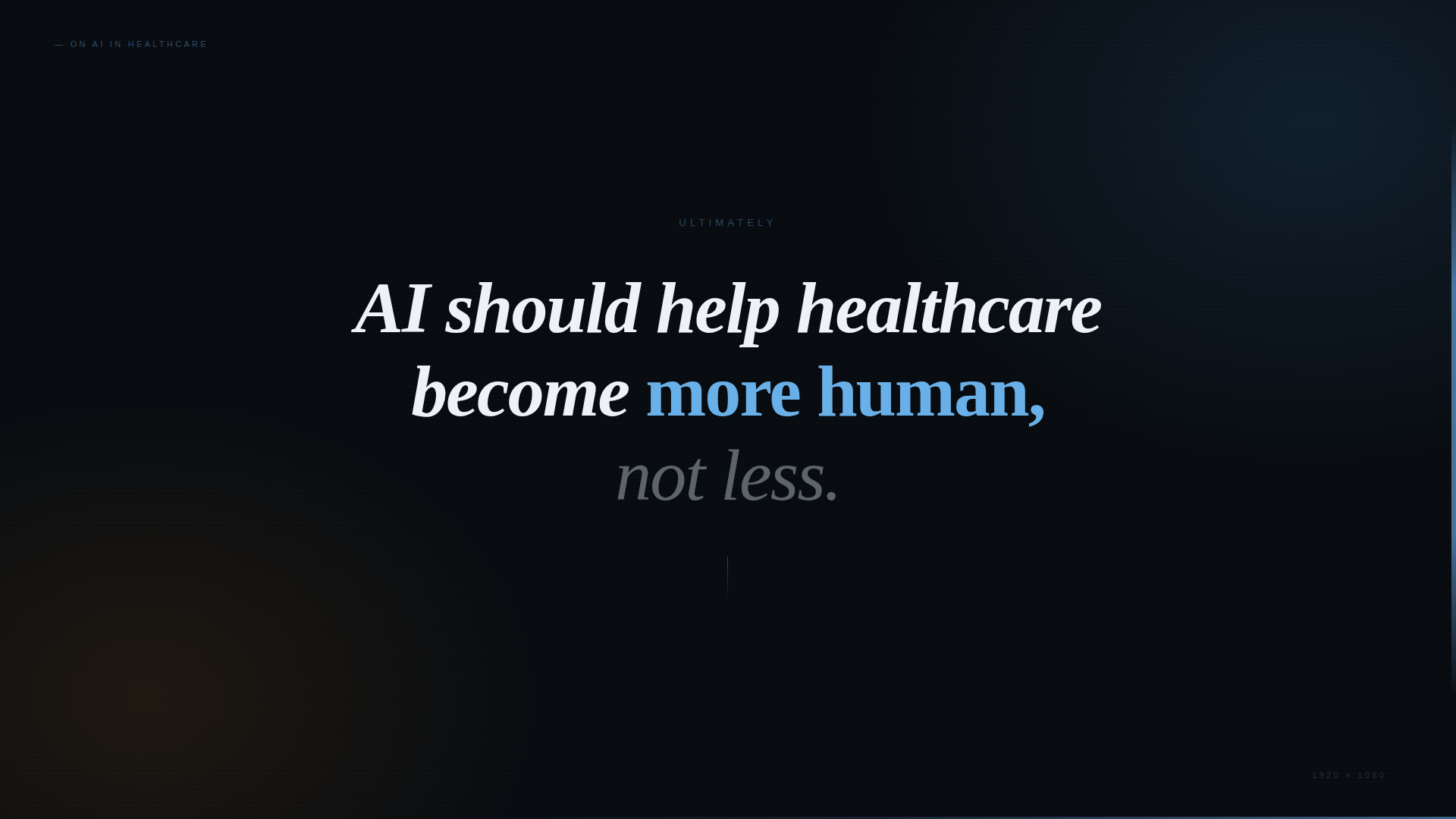
Ultimately, AI should help healthcare become more human, not less. By managing administrative burdens and reducing processing times, AI can reduce burnout and allow healthcare professionals to spend more meaningful time with patients while building stronger relationships.
When human compassion is combined with AI’s intelligence and speed, the result is a healthcare system that is not only more efficient and patient-centric but also one that sets a new benchmark for empathy and excellence.
Sumit Bharadwaj is Executive Vice President at CitiusTech, where he leads Delivery and Operations with a focus on digital transformation, GenAI, and customer success. With over three decades of experience in software services, including nearly 20 years in global healthcare IT, he brings deep expertise across payers, providers, and MedTech. Over his 16+ years at CitiusTech, he has played a key role in scaling operations, driving innovation, and delivering large-scale healthcare solutions. An alumnus of INSEAD, he is passionate about mentoring teams and leveraging emerging technologies to shape the future of healthcare.