

India is the most populous country in the world, so it is no surprise that it also has one of the largest workforces globally, making its talent pool a goldmine for organisations.
The numbers reflect this potential. According to the Stanford AI Index Report, India leads the world in AI talent hiring growth, with an annual hiring rate of 33%. The country’s concentration of AI professionals has also grown more than threefold since 2016.
Yet for years, India’s talent story has largely been told through metro cities such as Bengaluru, Delhi NCR, Hyderabad, Mumbai, and Chennai. While these cities have played a major role in driving growth, this metro-first mindset has also limited how organisations view the broader workforce opportunity across the country.
The Myth of Metro-Centric Talent
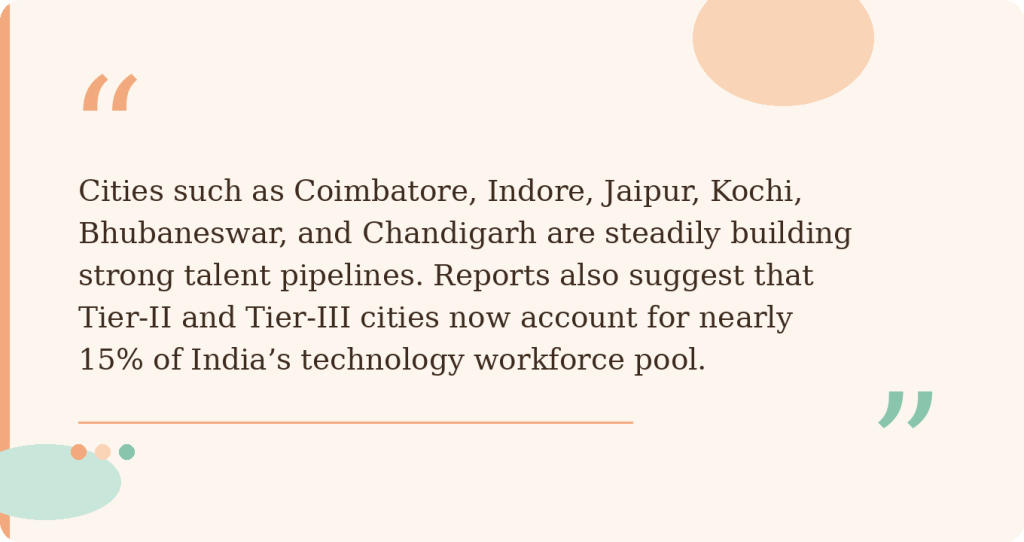
Metro cities continue to be important talent hubs, but they no longer hold a monopoly on skilled professionals. Across India, a quieter but significant shift is underway. Tier-II, Tier-III, and even Tier-IV cities are producing highly capable, job-ready professionals at scale. Cities such as Coimbatore, Indore, Jaipur, Kochi, Bhubaneswar, and Chandigarh are steadily building strong talent pipelines. Reports also suggest that Tier-II and Tier-III cities now account for nearly 15% of India’s technology workforce pool.
Before anyone wonders, “Why is this happening?”, the reasons are actually quite simple.
The gap between metros and smaller cities is narrowing, with better internet connectivity, stronger digital infrastructure, and wider exposure to global work standards. These improvements have made it possible for professionals to grow from anywhere.
The companies that continue to hire only from metros risk overlooking a significant and growing section of India’s talent base.
What is Driving this Shift?
One of the major factors behind this shift is access to learning.
Today, the younger population has access beyond traditional colleges and universities. Private institutions, bootcamps, and online learning platforms have made quality education accessible across geographies. A skilled professional can now learn coding, product management, AI, or analytics from anywhere in the world, virtually. Talent no longer needs to relocate to become employable.
Second, the aspirations of young professionals today have evolved significantly. They seek careers in technology, product, and data-led roles. Many now prefer to stay in their hometowns while working for companies located elsewhere.
Third, organisations themselves are changing. Distributed teams and remote work models are now more common than ever. Estimates suggest that by 2025, between 60 and 90 million Indians could be working remotely, which is approximately 10.12% to 15.7% of the country’s workforce.
Hiring is gradually shifting from a location-first model to a skill-first one. However, it is important to understand that hiring from non-metros goes beyond just expanding the talent pool.
The Advantages Many Companies Still Overlook
Expanding hiring beyond metros is not only about widening the professional pool; it also brings strategic advantages. For instance, talent from Tier-II and Tier-III cities often demonstrates strong intent and long-term commitment. Many individuals are first-generation professionals who deeply value growth opportunities. This can positively impact retention in the metro market, where attrition often ranges between 20%-25%.
Second is the cost advantage. Salary expectations for people from Tier-II, Tier-III cities are often more balanced compared to inflated metro benchmarks. This enables businesses to build high-quality teams without unsustainable compensation pressure.
Then comes diversity. Teams built across multiple geographies bring different perspectives, lived experiences, and problem-solving approaches. This often results in better decision-making and stronger innovation.

The Rise of India’s New Tech Hub
With steady improvement in infrastructure, policy support, private educational platforms, and local ecosystems, India’s next generation of tech-hubs is already emerging.
Cities such as Ahmedabad, Mysuru, and Nagpur are attracting start-ups, Global Capability Centres (GCCs), and mid-sized tech firms from across the world. As traditional hubs become increasingly saturated and expensive, these Tier-II, Tier-III, and Tier-IV cities are becoming viable choices for both talent acquisition and business expansion.
What is especially encouraging is that this growth is not limited to one region. It is spread across India, making the country’s talent ecosystem more balanced, resilient, and future-ready.
There’s yet another benefit to this expansion beyond metros.
A Major Opportunity: Rising Participation of Women in India’s Tech Workforce
Women today make up roughly 31% India’s tech workforce. Encouragingly, participation is growing faster in Tier-II and Tier-III cities. This is driven by modern career opportunities such as remote work, improved access to learning, and local job availability. For many, staying closer to family support systems removes barriers that previously limited career progression.
Ink Dive: AI as an Ally: How Women’s Perspectives Shape Ethical Workplaces
This gives organisations access to a highly capable talent segment that has historically been underutilised.
One of India’s greatest strengths has always been its scale and diversity. Nowhere is that more evident than in its evolving tech talent landscape. The next wave of growth will not come only from metro cities; it will come from across the country, from the talent that already exists.
The challenge lies in whether organisations are willing to look for it in the right places.
Prateek Shukla is the Co-Founder and CEO of Masai, India’s fastest-growing outcome-driven edtech platform. An alumnus of IIT Kanpur and a serial entrepreneur, he is deeply committed to addressing India’s education and unemployment challenges. His journey began with an internship at Teach For India, where grassroots exposure shaped his purpose. In 2019, a visit to Kenya and Tanzania further strengthened his belief in community-led, skills-first learning after engaging with the Masai Mara tribe. He co-founded Masai in June 2019, where he focuses on driving growth and strategy, scaling operations, building partnerships, aligning curriculum with industry needs, and delivering outcome-driven education.