

We tend to think hiring is a process. It is not. It’s one of the most consequential decisions any organisation makes, not because of the roles being filled, but because of the people who go on to define what the organisation becomes. Companies are not built on strategies or structures alone. They are shaped, day by day, by human judgement, ambition, and unpredictability.
For decades, hiring has reflected this reality—imperfect, interpretive, and deeply human. That is precisely why the shift we are witnessing today feels so significant. For the first time, decisions once guided almost entirely by experience and intuition are now being informed, and at times led, by artificial intelligence.
This transition is also inviting a different kind of attention to how hiring decisions are made. Recruitment teams are working through rising application volumes, tighter timelines, and growing expectations around the quality of each hire. In this environment, AI is becoming part of the process in a meaningful way. And as it does, organisations are beginning to look more closely at what it changes, not only in terms of efficiency, but in how we understand accuracy, fairness, and accountability in hiring outcomes.
The Efficiency Imperative Driving AI Adoption
The primary driver behind AI adoption in hiring is efficiency. Recruitment functions are dealing with significantly higher application volumes, driven in part by digital job platforms and AI-assisted job applications. AI systems help manage this scale by automating repetitive and time-intensive tasks such as résumé screening, candidate sourcing, and interview scheduling.
At TVH, we are experiencing the same trend. To support our growth ambitions, the Pune office is being elevated to our third global hub alongside Belgium and the US—shifting its focus from capacity and delivery to capability and innovation. This strategic move has sharply increased recruitment demand, making greater efficiency in hiring essential to meet our timelines and deliver on our recruitment goals.
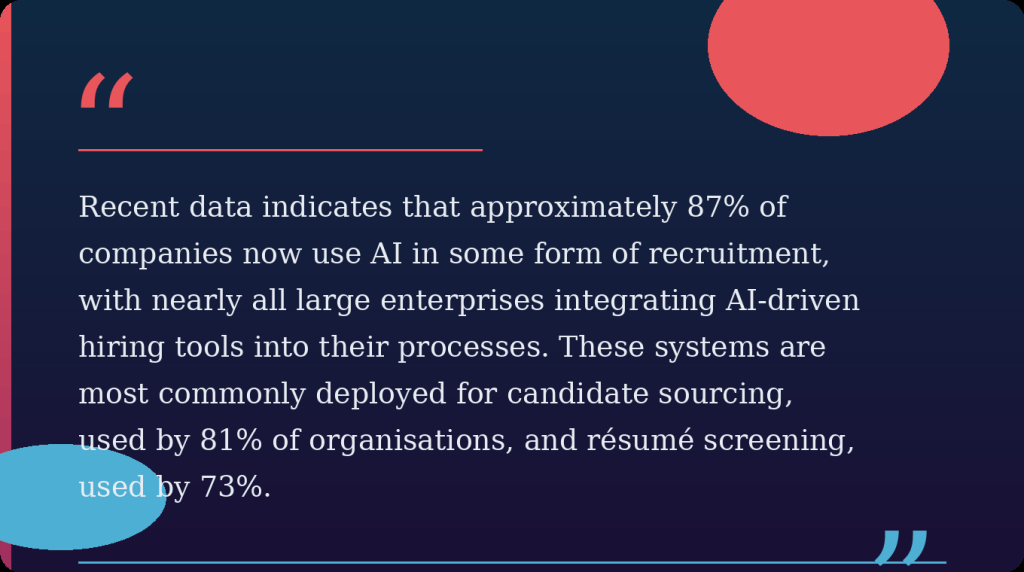
Recent data indicates that approximately 87% of companies now use AI in some form of recruitment, with nearly all large enterprises integrating AI-driven hiring tools into their processes. These systems are most commonly deployed for candidate sourcing, used by 81% of organisations, and résumé screening, used by 73%.
Ink Dive: What India Gets Wrong About Where Its Tech Talent Lives
The efficiency gains are measurable. AI-driven hiring can reduce time-to-hire by up to 50%, compressing processes such as résumé screening from several days to a matter of hours or a couple of days. Cost efficiencies are equally significant, with companies reporting 30–40% reductions in recruitment costs after adopting AI tools.
In India, this momentum is reflected in hiring trends. Recruitment activity grew by 15% in 2025, with AI-led hiring acting as a central driver. Demand for AI-related roles is also expanding rapidly, with projections indicating a 32% increase in 2026.
For organisations managing large-scale operations, these efficiencies translate into faster workforce deployment, improved project timelines, and better alignment between demand and talent availability.
Improving Hiring Precision
In addition to speed, AI promises improved decision accuracy. Advanced algorithms analyse candidate data across multiple dimensions, including skills, experience, behavioural patterns, and even communication cues in video interviews. This allows organisations to move beyond keyword-based filtering towards more nuanced talent matching.
Studies suggest that AI-powered screening tools can achieve accuracy rates between 89–94% and 89% in matching candidates to job requirements. Additionally, organisations using AI report up to a 50% improvement in quality-of-hire metrics.
AI also enables a shift towards skills-based hiring. Experimental research shows that candidates with AI-related skills are significantly more likely to receive interview invitations, with increases ranging from 8–15% points. This reflects a broader shift in hiring priorities, with demonstrable capabilities gaining precedence over traditional credentials.
The Emerging Risk Landscape
The integration of AI into hiring introduces risks inherent in how these systems operate. These risks are most visible in areas where data, decision logic, and human judgment intersect.
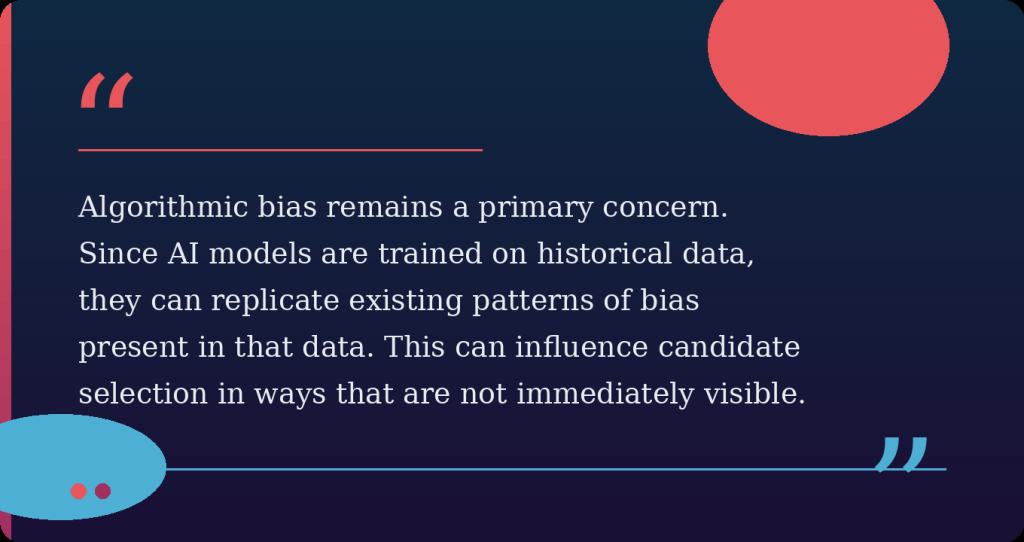
Algorithmic bias remains a primary concern. Since AI models are trained on historical data, they can replicate existing patterns of bias present in that data. This can influence candidate selection in ways that are not immediately visible.
Recent research has also identified ‘self-preference bias,’ where AI systems tend to favour résumés generated using similar tools. This creates a feedback loop in which AI influences both the creation and evaluation of applications, raising questions around fairness and standardisation.
Over-reliance on AI is another critical issue. Studies show that human evaluators may defer to algorithmic recommendations, even when inaccuracies exist. This weakens the effectiveness of human oversight and can reinforce flawed outcomes.
Transparency and Accountability Gaps
A significant challenge in AI-driven hiring is the limited transparency of decision-making processes. Many systems operate with low interpretability, making it difficult to explain why certain candidates are shortlisted or rejected.
This lack of clarity becomes particularly relevant as regulatory expectations evolve. Organisations are increasingly expected to demonstrate fairness, auditability, and accountability in hiring practices. As a result, explainability is becoming an operational requirement rather than a technical enhancement.
Balancing Automation with Human Judgment
The role of AI in hiring is most effective when positioned as a support system rather than a standalone decision-maker. Its strengths lie in processing large datasets and identifying patterns. Its limitations remain in contextual interpretation and ethical evaluation.
As a result, organisations are adopting hybrid hiring models. AI is used to streamline early-stage processes such as screening and shortlisting, while final decisions are validated through human assessment. This approach allows organisations to retain efficiency benefits while maintaining control over critical decisions.
Continuous monitoring is also essential. AI systems evolve based on the data they process, which makes periodic evaluation and recalibration necessary to ensure consistent outcomes.
Strategic Implications for Organisations
The use of AI in hiring presents a strategic balancing act. On one side, it delivers clear operational advantages in speed, scalability, and cost efficiency. On the other hand, it introduces risks that can affect hiring quality and organisational credibility.
Managing this balance requires structured implementation. Organisations need to define where AI adds value, establish oversight frameworks, and ensure alignment with internal policies and broader ethical standards.
AI is becoming integral to recruitment, but its effectiveness depends on how it is governed. The focus is shifting from adoption to responsible utilisation, where efficiency gains are matched with accountability and informed decision-making.
Vishal Rajani leads India operations at TVH as Head of the Global Capability Centre (GCC) and Managing Director, where he is responsible for strengthening TVH India’s role within the company’s global network. Since joining TVH in 2012, he has played a central role in building and scaling its presence in India from the ground up, shaping it into a key capability centre supporting global functions such as customer service, supply chain, operations, data, and technology-led capabilities. Under his leadership, the India business has evolved into an integral part of TVH’s international operations, contributing to both regional growth and global delivery.