


Eighteen months ago, when we began our AI transformation at Diligent, we faced a reality common to many organisations: our engineers were curious about AI, but few knew how to effectively integrate it into their daily work. We needed to move quickly, but also strategically, with a focus on long-term success.
We started with a straightforward approach: meet engineers where they are and help them grow through targeted reskilling and upskilling programs. This led to the creation of our AI-Curious to AI-Native progression path, which empowers engineers to experiment with coding tools like GitHub Copilot or Cursor within their existing projects – using AI to enhance their skills, not replace them. As our teams learned to leverage AI, we were able to scale AI adoption, making engineers more productive while enabling them to build AI-powered features for our customers. We have seen engineers who were initially skeptical become our biggest champions, especially when they experienced a 30-40% reduction in routine coding tasks, freeing them to focus on solving complex problems.
To ensure consistency across locations, from Bangalore to New York, we have established standardised AI reference architectures and regular cross-regional knowledge exchanges. For example, engineers in India might solve a problem using a particular AI framework one week, and by the next week, their counterparts in the US can quickly build on that same approach.
We also rigorously track AI adoption. Using analytics tools, we can see which teams are embracing AI tools, identify skill gaps, and provide targeted support. This data-driven approach helps us invest training resources where they'll have the most impact.
The most rewarding part of this journey has been watching junior engineers transform into mentors and key contributors to our AI-native product features, often within just six months of starting their AI journey.
Q/ How do you support your software engineers as they transition into AI-focused roles? For example, what mix of training, mentoring, hands-on projects, or certification opportunities are provided? How do you evaluate success through internal placements, AI-based deliverables, or retention metrics?
We learned early that training someone to become AI-competent through courses alone isn’t enough. They need hands on experience to truly understand it. Our approach is built on three pillars: structured learning, peer mentorship, and real-world application.
For structured learning, we provide access to LinkedIn Learning and vendor-led programs, which are carefully curated to provide relevant and practical applications. These training solutions empower our software engineers to leverage AI in solving real customer problems.
The mentorship component has been transformative. We designate experienced engineers as "on-the-floor mentors"—not formal trainers, but colleagues who can provide immediate help when someone gets stuck implementing an AI feature. We also run quarterly hackathons where cross-functional teams tackle real business challenges using AI. These aren't just learning exercises; several hackathon projects have been successfully integrated into production.
Perhaps most importantly, we assign meaningful AI projects to engineers from day one of their transition. For example, one team recently built an internal intelligent document analysis feature using vector databases and large language models—technologies they had no experience with six months ago. The learning curve was steep, but the sense of accomplishment was immense.
We measure success through tangible outcomes: the number of AI-powered features shipped, productivity gains in development cycles, and yes, retention rates. Based on what we’re seeing in the industry, engineers who've transitioned to AI roles show a 25% higher retention rate than those in traditional roles. They are more engaged because they're working on cutting-edge technology that's genuinely exciting.
We also celebrate publicly. When engineers earn AI certifications or deliver breakthrough features, we recognize their contributions organization-wide. This creates a virtuous cycle where more engineers want to participate in our AI journey.
Q/ What frameworks do you have to ensure responsible, secure use of AI in development? How do you address data privacy concerns, maintain code quality in AI-generated output, and implement review or auditing controls especially when agent-driven development is in play?
Trust is everything in our industry. Our clients—boards of directors, legal teams, compliance officers—rely on us to protect their most sensitive information. So, when we embraced AI-assisted development, we made sure that our AI principles met the highest safety, security and ethical standards.
We've established what we call "guardrails with freedom"—clear boundaries that protect data and quality while giving engineers room to innovate. Every line of AI-generated code undergoes the same rigorous review process as human-written code. First, the engineer who used AI reviews and understands the generated code —no blind copy-paste. Then, the code goes through peer review via structured pull requests. Only after approval from multiple human reviewers does it reach production.
On data privacy, we're uncompromising: customer data is never used to train our models, never crosses customer boundaries, and never leaves our secure environment. When we use cloud-based AI services, we ensure contractual protections are in place, and we're transparent with customers about what technologies we're using.
We've also embraced test-driven development more rigorously in the AI era. Automated test harnesses quickly catch regressions, which is especially important when AI tools might generate code that works but introduces unexpected side effects.
Perhaps the most important control is cultural: we've trained our engineers to think critically about AI outputs. They understand that AI is a tool that can accelerate their work, but they remain accountable for every line of code. We don't want "AI operators"—we want skilled engineers who leverage AI thoughtfully.
When we deploy AI-generated content for customers, such as automated summaries or insights, we clearly label it as AI-generated and prompt users to validate it. Transparency builds trust.
The result? We've accelerated development cycles without compromising security or quality.
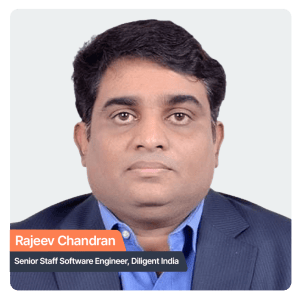
Q/ Could you elaborate on how Diligent's AI transformation framework is being implemented across the Software Development Lifecycle (SDLC)? Specifically, how are tools like Cursor, Co-Pilot, and AWS Bedrock integrated, and what measurable impacts have you observed on development velocity and quality?
At Diligent, our AI transformation is about becoming an AI-native organization — not just layering tools but reimagining how software is built. We’re embedding AI across the entire Software Development Lifecycle (SDLC), from discovery and planning to design, development, testing, deployment, and maintenance. This transformation is driven by tools like Cursor, which enable AI-native development environments, and AWS Bedrock, which supports scalable integration of foundation models. To empower intelligent automation and decision-making, we’re developing AI-powered search capabilities, agentic frameworks for orchestrating complex multi-step tasks, and adaptive workflows that dynamically respond to context and user intent. These innovations are accelerating delivery, enhancing quality, and unlocking new levels of developer productivity.
Q/ With a reported ~42% gap in AI and platform engineering roles at Indian GCCs (per Quess Corp), how is Diligent addressing this through internal reskilling?
At Diligent, we’re proactively addressing the growing talent gap in AI and platform engineering roles across Indian GCCs, through a comprehensive internal reskilling initiative. This program focuses on three strategic areas: transforming existing developers into AI engineers by providing hands-on training in machine learning, model deployment, and ethical AI; preparing teams for agentic integration to enable the design and management of autonomous AI systems that enhance enterprise workflows; and equipping engineers with skills in fine-tuning foundation models and leveraging platforms like AWS Bedrock to build scalable, secure AI solutions tailored to business needs. This initiative not only bridges the talent gap but also empowers our teams to drive innovation from within.
Q/ How is Diligent positioning itself to emerge as an AI first company by ‑mid‑2026?
Since beginning our AI journey eighteen months ago, Diligent has been executing on a comprehensive transformation across its platform, products, and governance ecosystem. This vision is being realized through the following key initiatives:
- Embedding AI Deeply into the Diligent SaaS Platform
- Accelerating AI-Driven Innovation
- Enhancing Education and Governance Resources
- Commitment to Ethical AI Use
Diligent India is not just adopting AI—it’s rearchitecting its platform and practices around it. It has established itself as a leader in AI-powered governance, enabling organizations to make better decisions faster, with clarity, confidence, and compliance at the core.