


India’s ambition to hit a $30 trillion economy by 2047 is more than just chasing a lofty goal or a tech revolution. It’s about something deeply personal and often overlooked, the pivotal role of women in the workforce.
Imagine this: Our economic future hinges on unlocking the potential of half the population. It’s not just about filling gaps or reaching targets, it’s about empowering women and transforming the entire economic landscape. If you’re curious about how this could reshape India’s future, let’s dive in and explore why increasing female workforce participation isn’t just important, it’s absolutely essential.
Unleashing the Potential
India needs to add 400 million women to the workforce to contribute an extra $14 trillion to the economy by 2047. As per ET, that’s not just a big number; it’s almost double the current female labour force participation rate (LFPR) of 37%. We’re talking about pushing that rate to 70%.
Sounds daunting, right? It’s because it is. But here’s the thing, if we manage this, we’re not just hitting economic targets; we’re unlocking a treasure chest of potential that’s been sitting on the sidelines.
Globally, countries where women actively participate in the workforce see faster economic growth. Look at East Asia and sub-Saharan Africa, where around two-thirds of women of working age are in the labour market. Contrast that with South Asia, where less than a third of women work. For India, stepping up female participation is not just about meeting economic targets; it’s about ensuring long-term, inclusive growth.
India’s Current Reality
Women in India are facing significant challenges in the workforce. They were found to be seven times more likely to lose their jobs and eleven times more likely not to recover from job loss. By 2020, nearly half of the women employed in 2019 had exited the workforce.
Women predominantly work in low-productivity sectors like agriculture and manufacturing, where advancement opportunities are scarce. In the construction industry, for example, women make up just over 12% of the workforce, often earning significantly less than men in unskilled roles. The pandemic has only worsened these issues, pushing many rural women back into work due to income loss or the job loss of the primary earner.
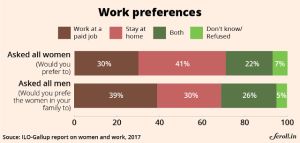
While global attitudes toward women working are generally positive, with the majority of both women and men favouring women in paid jobs, balancing work and family life remains a significant challenge. In India, the statistics tell a complex story: 30% of Indian women express a desire for paid jobs, 22% want to work while also managing family care, and 41% prefer to stay at home.
Interestingly, Indian men seem more supportive of women working. About 39% want the women in their families to have paid jobs, 26% support them juggling both jobs and family care, while 30% prefer them to stay at home.
If the majority believe in equal opportunities for women, why do the numbers tell a story of decline and exclusion?
Source - https://scroll.in/article/831095/womens-day-indian-men-are-more-open-to-women-working-even-more-open-than-indian-women
A Path Forward: Three Crucial Steps
So, how do we change this narrative? According to The/Nudge Institute’s latest report, there are three key pathways to boosting female labour force participation:
Redefine Work: The gig economy and digital microwork offer flexible opportunities that could help integrate more women into the workforce. By embracing platform jobs, we can create new ways for women to work that fit their diverse needs and circumstances.
Enhance Entrepreneurship: There’s a huge potential in digital commerce to fuel female entrepreneurship. By improving digital infrastructure and supporting women-led businesses, we can stimulate economic activity and create new jobs.
Address Bottlenecks: Mobility issues and lack of digital access are significant barriers. Improving transport options and expanding internet access can make it easier for women to enter and stay in the workforce.
The Bigger Picture: Skills and Job Creation
It’s not just about getting more women into jobs; it’s also about creating the right kind of jobs. The focus needs to be on education and skills training, especially in emerging technologies and capital-intensive sectors. This isn’t just about moving away from agriculture—it’s about enhancing productivity and creating formal-sector jobs that offer better security and advancement opportunities.
Sectors like construction, retail, and manufacturing have room to expand, but so do fields like real estate and financial services. India’s economic growth can’t rely solely on traditional sectors; it needs a diverse, thriving job market to accommodate a growing workforce.
Bridging the Gap: Challenges and Opportunities
Boosting female participation in the workforce isn’t just an economic challenge; it’s deeply intertwined with social and cultural dynamics. Women face a maze of barriers, from deeply entrenched social norms to a lack of adequate job opportunities. To make real progress, policymakers must confront these challenges directly. This means improving education for women, offering affordable childcare, and ensuring safer transport options.
But it’s not just about getting women into the workforce; it’s about ensuring they find decent, fulfilling jobs. This requires addressing gender-specific constraints and making sure women can access and fully benefit from the new economic opportunities that come with a growing economy.
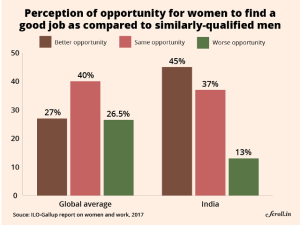
The ILO-Gallup survey shed light on the gap between perception and reality when it comes to job opportunities for women. Respondents were asked if men and women with similar education and experience have equal chances of finding jobs where they live. Globally, 40% of respondents believed that women have the same opportunities as similarly qualified men. Interestingly, 27% thought women have better chances, while 26.5% believed women have worse opportunities.
In India, the perception is somewhat more optimistic: 45% of respondents believe that women have better job opportunities than similarly qualified men. Meanwhile, 37% think women have equal opportunities, and only 13% feel women are at a disadvantage compared to men.
If the perception is so positive, why does the reality still tell a different story for women in India?
The Unfinished Business
The journey to a $30 trillion economy is about more than just hitting a financial target; it's about redefining whIndia’s ambition to hit a $30 trillion economy by 2047 is more than just chasing a lofty goal or a tech revolution. It’s about something deeply personal and often overlooked, the pivotal role of women in the workforce. Imagine this: our economic future hinges on unlocking the potential of half the population. It’s not just about filling gaps or reaching targets, it’s about empowering women and transforming the entire economic landscape. If you’re curious about how this could reshape India’s future, let’s dive in and explore why increasing female workforce participation isn’t just important, it’s absolutely essential.
Unleashing the Potential
India needs to add 400 million women to the workforce to contribute an extra $14 trillion to the economy by 2047. As per ET, that’s not just a big number; it’s almost double the current female labour force participation rate (LFPR) of 37%. We’re talking about pushing that rate to 70%.
Sounds daunting, right? It’s because it is. But here’s the thing, if we manage this, we’re not just hitting economic targets; we’re unlocking a treasure chest of potential that’s been sitting on the sidelines.
Globally, countries where women actively participate in the workforce see faster economic growth. Look at East Asia and sub-Saharan Africa, where around two-thirds of women of working age are in the labour market. Contrast that with South Asia, where less than a third of women work. For India, stepping up female participation is not just about meeting economic targets; it’s about ensuring long-term, inclusive growth.
India’s Current Reality
Women in India are facing significant challenges in the workforce. They were found to be seven times more likely to lose their jobs and eleven times more likely not to recover from job loss. By 2020, nearly half of the women employed in 2019 had exited the workforce.
Women predominantly work in low-productivity sectors like agriculture and manufacturing, where advancement opportunities are scarce. In the construction industry, for example, women make up just over 12% of the workforce, often earning significantly less than men in unskilled roles. The pandemic has only worsened these issues, pushing many rural women back into work due to income loss or the job loss of the primary earner.
While global attitudes toward women working are generally positive, with the majority of both women and men favouring women in paid jobs, balancing work and family life remains a significant challenge. In India, the statistics tell a complex story: 30% of Indian women express a desire for paid jobs, 22% want to work while also managing family care, and 41% prefer to stay at home.
Interestingly, Indian men seem more supportive of women working. About 39% want the women in their families to have paid jobs, 26% support them juggling both jobs and family care, while 30% prefer them to stay at home.
If the majority believe in equal opportunities for women, why do the numbers tell a story of decline and exclusion?
Source - https://scroll.in/article/831095/womens-day-indian-men-are-more-open-to-women-working-even-more-open-than-indian-women
A Path Forward: Three Crucial Steps
So, how do we change this narrative? According to The/Nudge Institute’s latest report, there are three key pathways to boosting female labour force participation:
Redefine Work: The gig economy and digital microwork offer flexible opportunities that could help integrate more women into the workforce. By embracing platform jobs, we can create new ways for women to work that fit their diverse needs and circumstances.
Enhance Entrepreneurship: There’s a huge potential in digital commerce to fuel female entrepreneurship. By improving digital infrastructure and supporting women-led businesses, we can stimulate economic activity and create new jobs.
Address Bottlenecks: Mobility issues and lack of digital access are significant barriers. Improving transport options and expanding internet access can make it easier for women to enter and stay in the workforce.
The Bigger Picture: Skills and Job Creation
It’s not just about getting more women into jobs; it’s also about creating the right kind of jobs. The focus needs to be on education and skills training, especially in emerging technologies and capital-intensive sectors. This isn’t just about moving away from agriculture—it’s about enhancing productivity and creating formal-sector jobs that offer better security and advancement opportunities.
Sectors like construction, retail, and manufacturing have room to expand, but so do fields like real estate and financial services. India’s economic growth can’t rely solely on traditional sectors; it needs a diverse, thriving job market to accommodate a growing workforce.
Bridging the Gap: Challenges and Opportunities
Boosting female participation in the workforce isn’t just an economic challenge; it’s deeply intertwined with social and cultural dynamics. Women face a maze of barriers, from deeply entrenched social norms to a lack of adequate job opportunities. To make real progress, policymakers must confront these challenges directly. This means improving education for women, offering affordable childcare, and ensuring safer transport options.
But it’s not just about getting women into the workforce; it’s about ensuring they find decent, fulfilling jobs. This requires addressing gender-specific constraints and making sure women can access and fully benefit from the new economic opportunities that come with a growing economy.
The ILO-Gallup survey shed light on the gap between perception and reality when it comes to job opportunities for women. Respondents were asked if men and women with similar education and experience have equal chances of finding jobs where they live. Globally, 40% of respondents believed that women have the same opportunities as similarly qualified men. Interestingly, 27% thought women have better chances, while 26.5% believed women have worse opportunities.
In India, the perception is somewhat more optimistic: 45% of respondents believe that women have better job opportunities than similarly qualified men. Meanwhile, 37% think women have equal opportunities, and only 13% feel women are at a disadvantage compared to men.
If the perception is so positive, why does the reality still tell a different story for women in India?
The Unfinished Business
The journey to a $30 trillion economy is about more than just hitting a financial target; it's about redefining who we are as a nation and what we truly value. But can we really call ourselves a growing economic force if half of our population is left behind?
How do we make sense of the fact that while perceptions of gender equality in the workforce are improving, the reality for millions of women in India is still bleak? Are we doing enough to break down the barriers that keep women from not just entering the workforce, but thriving in it? And can we afford to ignore the vast potential that women bring to the table if we’re serious about securing our economic future?
The conversation just doesn’t stop here, let’s ask these questions, face these issues head-on, challenge the status quo, and take decisive action to ensure that women in India are not just participants, but leaders in driving the change we need.
o we are as a nation and what we truly value. But can we really call ourselves a growing economic force if half of our population is left behind?
How do we make sense of the fact that while perceptions of gender equality in the workforce are improving, the reality for millions of women in India is still bleak? Are we doing enough to break down the barriers that keep women from not just entering the workforce, but thriving in it? And can we afford to ignore the vast potential that women bring to the table if we’re serious about securing our economic future?
The conversation just doesn’t stop here, let’s ask these questions, face these issues head-on, challenge the status quo, and take decisive action to ensure that women in India are not just participants, but leaders in driving the change we need.