

As Godrej DEi Lab celebrates its maiden anniversary, All Things Talent embarked on an insightful conversation with Parmesh Shahani, who heads the division. Parmesh shared insights into the strategies and core values that are transforming diversity and inclusion within the Godrej Industries Group. He talked about how embedding DEI goals within leadership performance metrics has fostered a more committed and innovative approach across the organisation. The discussion also addressed the challenges and opportunities of extending inclusivity beyond urban centers, ensuring safe and supportive environments for LGBTQ and diverse employees in smaller cities and, at the same time, offered a glimpse into the future of DEi Lab, with bold aspirations to reshape inclusivity across all workplaces.
Godrej DEi Lab has turned one. Congratulations. What have been the key challenges you have faced, the most significant changes you have witnessed, and what exciting initiatives or goals are on the horizon from hereon?
First of all, Thank You.
Although the lab just celebrated its first anniversary, DEI at Godrej has been a priority for many years. We have had a longstanding commitment to inclusion across our various businesses, whether it's Consumer Products, Agrovet, Properties, Capital and so on. Each of these divisions has worked over decades to fulfil our business purpose and uphold Godrej’s values. The lab was established a year ago to complement these efforts. So, while it’s one year for the lab, it’s also a reminder that much of the groundwork around inclusion was already being done across the group.
The lab essentially created a central hub to bring together and unify the DEI efforts within Godrej, providing a platform to share the initiatives each group company was working on. Additionally, the lab aims to build bridges with other companies in corporate India by sharing our journey and learning from others. It’s also fostering connections with research institutions and individuals in the DEI field. When we launched the lab, we set two key goals: firstly, to unify and act as a force multiplier for the DEI work across Godrej, and secondly, to create a space for other Indian companies to advance their own inclusion journeys.
Looking back at our first year, I think we are well on track with both these goals. Internally, we have collaborated not only with our different businesses but also with various teams across Godrej. We have developed a comprehensive diversity and inclusion scorecard to measure various metrics across the group. Additionally, we have initiated projects, such as the Women Veterans' Programme, which brings women veterans from India’s armed forces into Godrej. This is a pilot project that we are particularly proud of.
We have also worked with other Godrej teams to improve caregiving policies, covering self-care, child care, and elder care comprehensively. Self-care includes mental health counselling, unlimited sick leave, and similar provisions. For elder care, we have partnered with agencies to support employees’ parents when needed, and for child care, we have expanded our policies, referring to primary and secondary caregivers to accommodate all types of families.
On the public advocacy front, the lab has hosted large public events and produced documentaries on our DEI initiatives. We publish a monthly DEI newsletter, which now reaches about 40,000 readers across India. Recently, we launched a DEI directory as well.
Reflecting on the past year, I feel proud of the progress we have made. Our goal is to advance both Godrej and corporate India towards greater inclusion, and I believe we are firmly on that path. See, ultimately, we are one group, right? India will only change when every company thinks like that.
Some initiatives that are creating a lot of buzz are the Godrej Properties program to provide safe housing for transgender, genderqueer, and gender non-conforming employees and Godrej Capitalhas expanded its home loan program to include queer couples, reflecting the company’s commitment to broader societal inclusivity. What are some other novel initiatives that the organisation is currently carrying out?
So many. We are always thinking of how we can enhance and are constantly working on it. The good thing right now is that we have so many queer people in the system itself, right? So, we do not have to imagine what would be best – we can think along with our colleagues. Our colleagues continue to give us feedback, saying, ‘How about this?’ or ‘Should we try that?’ I think we have some of the best benefits, whether it is in same-sex partnership benefits or gender affirmation. I think our benefits are best in class. But beyond policies, it is about giving queer people who come on board the best experience in terms of sensitising colleagues, growing our queer leaders within the organisation, and celebrating accomplishments — all of which are ongoing.
We also have a very nice ERG, and our WhatsApp group with our Queer ERG members is always buzzing. Now that we have reached critical mass, that is when the real community experience begins. When there were just a few people, it was still a challenge. But now, with hundreds of queer people, the community is steadily growing. To me, more than the policies and processes, it is about the joy I feel when I go to lunch, for example, in the café, and I see a queer person at one table, another queer person at another table. When I leave, someone says, “Hi!”
That joy is indescribable because 10 years ago, I felt like I was the only one. Now, I cannot go to lunch without seeing others from the community. Sometimes we joke and ask each other, ‘Are there any straight people here too?’ For me, the feeling goes beyond policies. Of course, we are still a small group in comparison — in a big company like Godrej Properties, there are about 150 ‘out’ queer people, and I am sure there may be more who are yet to come out. But we are seeing the difference.
For me, the joy is in the daily culture. When you can go to work and see others being confident, being who they are, and sharing that moment of solidarity. That, to me, is as much an achievement as our policies and benefits, which will continue to evolve, because all of this is an ongoing conversation with our colleagues.
I’m sure you might get this a lot—The confusion between the Godrej India Culture Lab and the DEi Lab. My question to you is how does the former pass the baton of inclusivity to the latter and how much has the pandemic affected the idea of inclusivity?
The Culture Lab was very successful for 10 years, but during the pandemic, we chose to pause it temporarily. We were unsure when things would reopen, and online events, while attempted, did not quite work for us. Coming out of the pandemic, we reflected on the Culture Lab’s journey and achievements. We realised its most impactful contributions were in conversations about gender, LGBTQ+, and persons with disabilities (PwD), which resonated not only with Godrej employees but also with broader audiences.
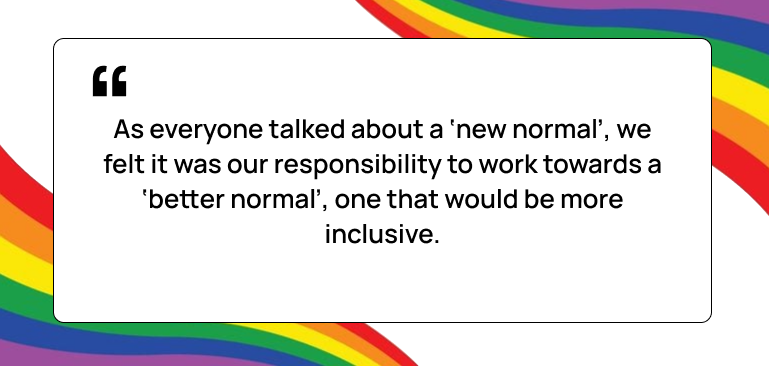
As everyone talked about a ‘new normal’, we felt it was our responsibility to work towards a ‘better normal’, one that would be more inclusive. Thus, we decided to evolve the Culture Lab into the DEi Lab, creating a more focused initiative aimed at widening the inclusion net. This includes our projects within the group as well as our public advocacy efforts, like events, videos, our DEI Directory, and more.
The pandemic was instrumental in shaping this more focused version of our work. It emphasised the urgency of building a future where more people are included and have the opportunity to participate meaningfully. This focus on inclusivity, we feel, is the need of the hour — creating a future that truly brings everyone along with it.
The Lab launched the first-of-its-kind public DEI Directory, a repository featuring over 500 curated resources on workplace inclusion. How does this tool provide organisations with access to extensive resources, guidance, and best practices to foster inclusivity across sectors?
Yes, the DEI Directory is our ‘one-year anniversary gift’ to the world. Although it’s our birthday, we decided to be the ones giving gifts! (laughs). Over the past year, we have curated this resource, and we are excited to offer it as a comprehensive toolkit. Often, organisations approach us saying, ‘I want to start something but don’t know where.’ With this directory, there are no more excuses, we have created a robust, easily searchable resource that covers so much. If you’re looking for PoSH trainers across India, they are listed. If you need research on how gender inclusivity benefits business, it’s there too.
We have compiled articles, academic research, websites, books, and consultants, organised into two sections: internal and external resources.
- For internal, we have included several resources developed within Godrej that we are now sharing widely.
- The external section is filled with recent research reports, manifestos, white papers, videos, and more.
It’s all on our website, where people can search by focus area and find exactly what they need.
Our hope is for HR professionals, students, researchers, and businesses to use it actively. It’s just a starting point with 500 resources; we know there’s so much more. In fact, we are encouraging users to share new resources they find. We wanted this to be a one-stop shop for inclusivity to push people towards action, as Nike would say, Just Do It. we are thrilled to see how it’ll be used for training, research, and more.

The Godrej One oral history project is capturing stories of inclusion and allyship from across the organisation. How do you believe storytelling creates a bridge between the company’s traditional values and the need for progressive, inclusive practices in today’s world?
Well, our values at Godrej have always been progressive. The company's foundational values have consistently revolved around goodness, trust, and creating a better world. We are talking about a 127-year-old legacy, rooted in the Swadeshi movement, with initiatives akin to Make in India dating back decades. This history speaks to values that have always promoted progress, equity, and inclusion.
The Godrej One Project emphasises the significance of storytelling because, within any organisation, you can mandate inclusion, adjust policies, and implement training, but it’s the stories that really make people feel and understand it. Changing minds can happen with data and training, but changing hearts happens through hearing and sharing impactful, real stories. We want the Godrej One Project to touch people’s hearts by spotlighting the inclusion already happening within our group.
This project, therefore, is more than just about DEI mandates. It’s a celebration of existing inclusivity. We have captured oral histories and photographs of employees who feel genuinely included, like the young woman in a factory in Malanpur, MP. Her grandfather encouraged her through college despite others’ doubts, and now, working at Godrej, she’s filled with pride. Or the story of a transgender woman who, after overcoming many struggles, has a fulfilling role here, contributing meaningfully to society.
We want the project to be a visible repository so people can see firsthand how inclusion changes lives and promotes joy and productivity. It’s available on our website, on social media, and displayed during public events and in our offices, where visitors can see and celebrate these stories too. Our goal is to build an extensive archive, with hundreds more stories added in the years to come, helping everyone realise that inclusion is beneficial across the board for business, society, personal well-being, and mental health alike. For us, it's making and documenting history, but it's also spreading positivity.
Decoding benchmarking in the gender context, studies suggest that contrary to outdated perceptions, the manufacturing sector today is a vibrant hub of innovation with a modest 25-33% inclusion of women. This stands in stark contrast to sectors like healthcare, where women's representation is significantly higher at 54%. While this is only female representation, in such conditions, especially in manufacturing or traditionally male-dominated sectors, how does one open the gates of inclusivity to all genders?
I think this is very exciting, because, as you know, at a national level, we are prioritising manufacturing right here in India. Manufacturing is set to boom across the country, and I see various ways to open those gates.
First, it is essential to recognise that historic challenges have always existed, but the good news is that many companies, state governments, and the national government are actively developing strategies to address these. For example, at our upcoming Godrej Consumer Products Limited factory in Tamil Nadu, we have committed to having 50% of the workforce as women, with 5% representation from Persons with Disabilities (PwD) and the LGBTQ community. Nisa Godrej made this commitment to the Honourable Chief Minister M. K. Stalin during the factory’s launch, and the state government has expressed strong support. They want to collaborate with us to make this a model for all future factories.
What I find particularly exciting is that state-level support is also growing. Policymakers increasingly recognise that manufacturing growth must go hand-in-hand with broadening opportunities for women, PwD, and the LGBTQ community. I am seeing companies committing to this inclusivity vision and state governments offering innovative solutions to make it happen. The upcoming decade is likely to bring significant shifts in manufacturing because there is genuine interest and action from all sides.
Of course, there are challenges including mindset shifts, preparing a diverse talent pool, and building facilities that cater to everyone’s needs. Creating inclusive factory setups, whether with appropriate washrooms, crèches, daycares, or transportation facilities, requires effort. However, I am observing real progress on the ground; not only within Godrej but also across other companies we regularly interact with.
This movement towards inclusion is crucial because manufacturing will be a major source of jobs in the future. Imagine the impact if we can fill those roles with a diverse workforce that includes women, persons with disabilities, and LGBTQ individuals. It is an exciting prospect, and I am truly encouraged by the positive steps that companies are taking.
For example, the Tamil Nadu factory is being designed as an inclusive space from the outset, with ramps, inclusive signage, and other accessibility features built into the planning. These innovations could serve as a model; once we demonstrate success, other companies will see it and say, ‘You achieved it, let us implement it too.’ This ripple effect could mean that within a decade, factories across India will embody this level of diversity and inclusivity.
Introducing DEI goals in the KRAs of leaders is a unique way to ensure accountability. In your experience, how has this influenced leadership mindsets and practices within the Godrej Industries Group?
It has actually been incredibly exciting and transformative. Our corporate HR team collaborates with senior leaders to define these DEI goals and then follows up to ensure they are being met.
This approach aligns strongly with our values at Godrej. We believe in holding ourselves accountable for our commitments, and this focus on accountability has already started to show remarkable results within just one year. Although the complete report will be finalised by next March, the data we are tracking shows tangible improvements. We are witnessing increases in representation for gender diversity, LGBTQ, and persons with disabilities, alongside a reduction in attrition rates.
Having these DEI goals has truly been transformative. We publish all our progress data annually in our corporate report, available for public access on our website. This transparent reporting process allows anyone to compare our progress between reports, seeing the positive changes year on year. The DEI goals have been a game-changer for us, absolutely.
We have seen our leadership teams wholeheartedly embrace and commit to these goals, often going beyond the targets they initially set. Our leaders are now embedding DEI not only in representation numbers but also in innovation. For instance, while a leader might set a goal to improve representation, that goal often prompts them to think creatively – perhaps by developing new products or solutions that reflect our inclusivity values. Because these goals are integrated into their official performance objectives, leaders are thinking about DEI structurally, which drives them to exceed the mandate. This is precisely what we aimed to achieve.
I believe this is one of the most significant steps a company can take. If senior leaders in every organisation set DEI goals as part of their mandate, we would see transformative change on a large scale.
Queer-friendly workspaces tend to emerge primarily in urban hubs. What strategies should companies adopt to extend queer inclusivity and safe work environments to employees in smaller cities or rural areas, where cultural resistance may be stronger?
I think companies must be very cognizant of the environment they operate in, with employee safety as the foremost priority. It is essential that employees feel safe, are well supported, receive all necessary benefits, and can genuinely be themselves. To achieve this, companies should develop robust, best-in-class policies grounded in a firm set of values.
Organisations must offer equitable benefits and focus on sensitising employees, setting conditions that allow inclusivity to flourish over time. Take, for example, gender inclusivity in manufacturing. It has taken time for companies to establish the infrastructure such as washrooms, daycare facilities, and training on appropriate behaviour in diverse settings to create a welcoming environment for women. As these practices took root, women’s numbers gradually increased, and over time, they had positive experiences and shared them, which further strengthened diversity in those spaces.
At Godrej, we apply the same approach to our LGBTQ and PwD inclusion efforts. While the largest concentration of queer employees is at Godrej Properties Limited, which typically operates in major cities, our queer colleagues are found across a diverse array of functions. In our manufacturing setups, we are starting to see similar changes. Recently, a transgender individual joined one of our manufacturing teams. To support this transition, we are working diligently with on-site teams to create a welcoming, sensitised environment, making the person comfortable. This creates a positive experience that encourages others in similar situations to view Godrej as a safe space, which in turn attracts more talent through word of mouth.
In rural and less urbanised environments, there may not yet be a large, established community, making the early stages of inclusion efforts particularly challenging. Therefore, companies must be thorough in executing foundational inclusion measures. For instance, values of inclusivity must be communicated and practised at the grassroots level. Employees need to understand what inclusive behaviour entails and recognise that this commitment is deeply embedded in the organisation’s ethos.
In these areas, organisations might have to drive inclusivity a bit more proactively than in urban areas, but the fundamentals remain the same. By consistently demonstrating what we stand for and building an inclusive environment step by step, we lay the groundwork for lasting change across diverse geographies.
In GIG’s annual report, there’s a line where you say, ‘Good businesses thrive on good workplaces and on a culture of doing good.’ In your view, what truly defines a ‘good workplace’ in an evolving business landscape?
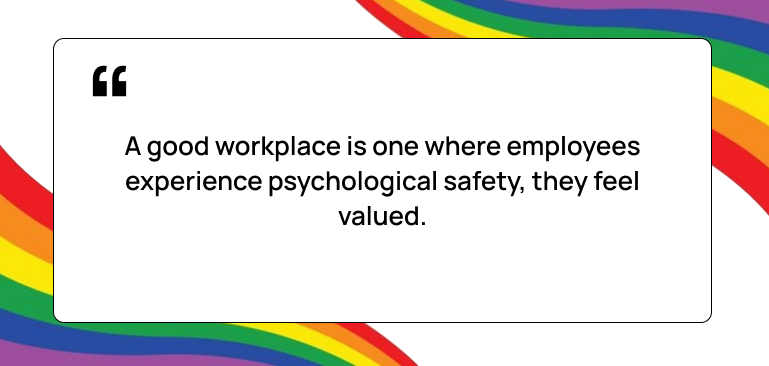
I think it ultimately comes down to the basics. This is not rocket science. A good workplace is one where employees experience psychological safety, they feel valued. And what does that mean? It means that employees feel they are genuinely taken care of, through policies, practices, and processes that protect and support them. They feel safe, valued, and free to bring their entire identity to work. This also means they feel trusted, both by their organisation and by their colleagues, fostering an environment where they can perform at their best.
We all spend a significant portion of our lives at work, so a good workplace should enable employees to feel valued and safe. Achieving this is not the result of one grand initiative; it is the accumulation of many small, ongoing actions. Companies that have grasped this and are consistently working on creating such an environment are the ones where employees continue to feel safe, empowered, and motivated to bring their best selves to work.
If employees are not comfortable, it is difficult for them to truly contribute their best. Therefore, focusing on creating a positive, safe environment is not only beneficial for employees; it also benefits the business. The well-being of employees directly influences the quality of their contributions, making this a win-win scenario. Embracing goodness and supporting employees may seem basic, but it is foundational for a thriving business.
Parmesh Shahani heads the Godrej DEi Lab at Godrej Industries, an experimental space promoting inclusion ecosystems within and beyond the Godrej Group. From 2011 to 2021, he founded and led the Godrej India Culture Lab, a multi-year project exploring the evolving nature of Indian society. He is the author of 'Gay Bombay: Globalization, Love and (Be)Longing in Contemporary India (2008)' and 'Queeristan: LGBTQ Inclusion in the Indian Workplace (2020)', the latter winning the 'CK Prahalad Prize for Best Business Book' and the 'Laadli Media Award for Gender Sensitivity' in 2021. Parmesh holds an MS in Comparative Media Studies from Massachussets Institute of Technology and is a 'TED Senior Fellow', 'Yale World Fellow', 'WEF Young Global Leader', and board member of 'KHOJ International Artists’ Association and Breakthrough'.