

"HR is not here to police you; it is here to guide you." With this refreshing perspective, Luan Lam, Chief People Officer at Harness, redefines the role of HR in an era of hybrid work and rapid technological advancement. From championing employee well-being with unique initiatives like 'Thank God It’s Friday' Off-days to nurturing talent through internal mobility, Luan shares actionable insights. He also unveils his predictions for 2025, where AI, curiosity-driven learning, and a culture of listening take centre stage.
A Glassdoor report indicates that 76% of job seekers consider company culture before applying for a position. Similarly, a LinkedIn report focused on the tech industry found that 40% of tech workers are actively seeking new roles. When looking for these positions, candidates prioritise company culture even before financial compensation. Given the competitive landscape for tech talent, how do you think this shift towards valuing cultural alignment is changing recruitment strategies for top-tier talent?
That is a great question. I would say that the first thing people do before applying for a job or even agreeing to an interview or an initial phone call is to do their homework on the company. The best way to research a company's culture, especially outside of India, is through platforms like Glassdoor. In the Indian market, for instance, we also utilise AmbitionBox, which is similar to Glassdoor. At Harness, we leverage both Glassdoor and AmbitionBox. I am happy to share that our Glassdoor rating is 4.0, which is typically very challenging to achieve. Many of our competitors, or companies in similar spaces, generally have ratings between 3.5 and 3.8. Achieving a 4.0 rating with over 500 reviews gives potential candidates a clear indication of our culture. I completely agree with you that culture plays a significant role in a candidate’s decision to opt into the interview process, let alone take up a job offer.
Since you spoke on the Indian markets, what cultural factors influence your recruitment approach in India? How do these factors differ from your strategies in Europe and the APAC region? Additionally, how is the Indian market affecting your hiring practices?
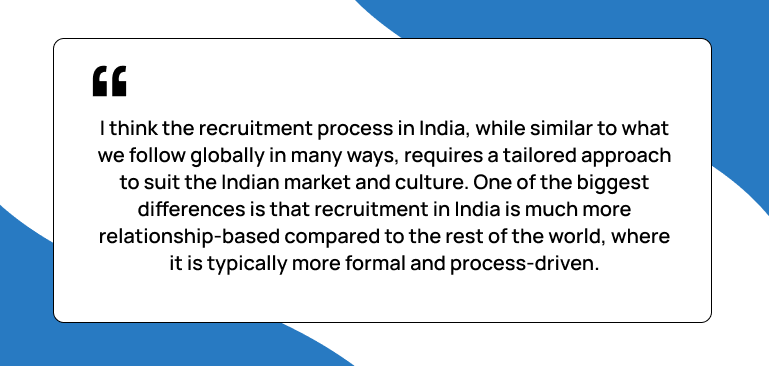
I think the recruitment process in India, while similar to what we follow globally in many ways, requires a tailored approach to suit the Indian market and culture. One of the biggest differences is that recruitment in India is much more relationship-based compared to the rest of the world, where it is typically more formal and process-driven. It's quite referral-based, right? For example, someone might say, ‘Hey, I am working at this company or I have heard about this company where my friend works,’ and that personal connection becomes a key driver in the recruitment process. It’s not that evident for the rest of the world.
Another major difference is the influence of family, which is a significant factor in India. This is something we also do not see in many other parts of the world, except in some APAC countries like Singapore, Japan or South Korea. In regions like Australia or New Zealand, the decision-making process is almost entirely individual-driven. In India, however, family influence plays a considerable role, and we need to account for that in our strategies.
Brand perception is another critical factor in India. The recognition and prestige associated with a company’s brand are highly valued. At Harness, we are fortunate to have a strong brand presence, but this is something we continuously work to improve. Our CEO, Jyoti Bansal, is a second-time CEO with an impressive track record at AppDynamics, which he grew and eventually sold to Cisco for $3.7 billion. His personal brand and success story resonate deeply with talent in India.
Additionally, communication style is a significant cultural difference. In India, candidates expect multiple and consistent touchpoints throughout the recruitment process. This contrasts with the more formal, process-driven approach seen in other regions.
Finally, growth opportunities are a top priority for candidates in India. They place significant emphasis on career advancement. In other parts of the world, candidates often focus more on company stability or aspects like diversity and inclusion. While diversity and inclusion are gaining importance in India, they are not yet as prominent as they are globally.
Are there specific skill sets currently in high demand within the tech industry? How do you see India contributing to the future of technology and innovation, especially with the recent developments in Global Capability Centers (GCCs)?
The question has two aspects:
- The trends in technologies and skill sets in the Indian market
- How India is contributing to the global economy and future innovation
In terms of in-demand skill sets, I would categorise them into current and emerging trends. Currently, cloud computing, DevOps, CI/CD, and cybersecurity are highly sought after in India. Securing technology is as critical as building it, and this need drives demand for cybersecurity expertise. Additionally, artificial intelligence and machine learning remain hot areas, continuing to dominate the technology landscape. Compared to other regions, India’s focus aligns uniquely. For instance, in Asia Pacific countries like China or Japan, smart city technologies take precedence, whereas Europe sees a rise in green and energy technologies.
Emerging trends in India include artificial intelligence, which has taken the world by storm, and blockchain technology, which is gaining rapid traction. Over the last few years, educational technology has also become a rising trend, with platforms catering to learning and development—a passion of mine as a people leader. It is refreshing to see EdTech evolve to meet deeper educational needs. Finally, fintech and payment technologies are burgeoning areas, transitioning from traditional software-driven companies to innovative, forward-thinking enterprises.
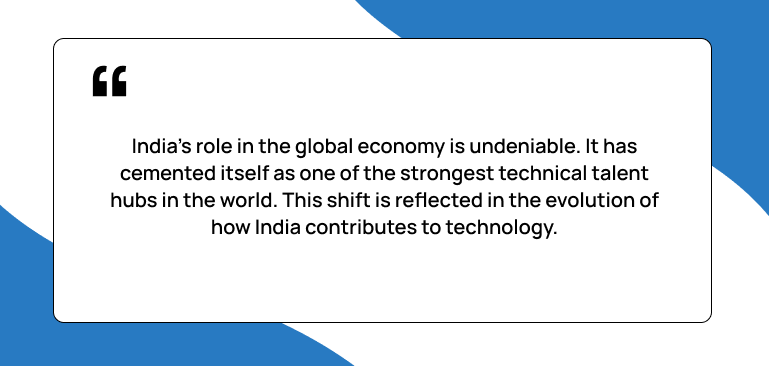
India’s role in the global economy is undeniable. It has cemented itself as one of the strongest technical talent hubs in the world. This shift is reflected in the evolution of how India contributes to technology. A decade ago, India’s role was often centred on client servicing and support functions for offshore-built products. Today, we see a significant shift where core product development and innovation are happening within India. Many companies now build their main product lines and modules here first, underscoring India’s strategic importance.
India’s contributions go beyond cost efficiency, offering high-quality technical talent at competitive rates. Additionally, there is a focus on leadership development, with homegrown executives being groomed to lead multinational corporations worldwide. This demonstrates India’s influence not just in technological innovation but also in shaping the global leadership landscape.
Ink Dive: GCC Recruitment Trends for 2025: Janoo Motiani on What HR Leaders Should Know
What initiatives are in place to upskill employees in response to the evolving demands of new technologies? Could you share some details about your upskilling policies?
I’d like to answer that in the context of perhaps an emergent skill set like AI and ML. So, one of the things we have done internally within the company is to take an inventory of the technical talent we have. So, if our AI initiative has been launched and we do not have a lot of individuals with that particular background, we would assess who has the relevant skills when it comes to AI.
The second step is applying future business needs related to AI to our workforce, and that is how we identify the gap analysis. Let us assume that we need 10 engineers with an AI background, and we only identify 3 internally. What that means is we need to hire 7.
This analysis allows us to have a factual, data-driven decision-making process. For instance, if we have identified a need for 7 AI engineers, we know we must go out and hire those 7. Internally, we also have a career framework that helps in two key ways:
- Identifying gaps
- Helping our engineers understand where they stand within the company and how they can move up to the next level
Now, going into the upskilling portion of it, we have a very robust learning and development arm within our company. We believe continuous learning is a part of our culture. In fact, we have rolled out a programme where all individuals are required to take a certain number of sessions, courses, or classes, whether instructor-led or online.
It is worth mentioning that you have to customise the career path or learning path for different groups within the organisation because it is not a one-size-fits-all model. For example, someone in HR will have a different set of requirements compared to someone in engineering, marketing, or sales. So, we cater to that.
Hackathons are a great way for us to showcase talent, let people innovate, and upskill as well. Once a year, we organise a hackathon that runs for about a week to 10 days. This provides management with an opportunity to identify great dreamers and innovators within the company to invest in. At the end of the hackathon, some of the ideas are often integrated into our product lines, and contributors are rewarded.
Certification programmes, both internal and external, are something we actively encourage. For instance, if a technical employee wants to get certified in a certain product line that we offer, they can do so. Similarly, if there are external technical certifications they wish to pursue, we support that as well.
Finally, I cannot stress enough the importance of our learning and development arm. Microlearning is a key concept here. Microlearning involves bite-sized modules that allow people to learn new skills or improve existing ones quickly. For example, employees can develop better communication styles in just 30 minutes. This culture of continuous learning is what we are embedding in our organisation through our learning and development initiatives.
Referring back to the LinkedIn report, which stated that 40% of tech talent is seeking new opportunities, it also mentioned issues such as burnout and mental health challenges faced by employees globally, including those in India. How should companies address these challenges, and what strategies are you implementing to navigate these difficult times? While investing in upskilling and reskilling programmes, keeping employees engaged is also paramount. This is particularly important for leaders like you who manage diverse and global talent. How are you navigating these challenging times and this shift?
I would start by saying that this is likely the biggest challenge any people function faces today at any company. The reason is that, almost overnight, when COVID happened, the spotlight was suddenly on HRD. HR was tasked with ensuring everyone’s safety, motivation, and engagement. However, how do you achieve that when you cannot interact with people in person?
HR professionals were expected to become superheroes, with everyone looking to them to solve numerous challenges. Consequently, HR rapidly transformed from a more traditional or back-office function into a front-office one during COVID-19. The spotlight was so intense that there was no option but to act swiftly.
Now, addressing the points you raised individually:
Regarding the 40% of individuals looking for opportunities, one of the initiatives we implemented at Harness, particularly post-COVID, is maintaining a hybrid work model. We do not require employees to be in the office full-time. Some work in-office, while others work remotely. Ensuring high levels of engagement in this hybrid setup is crucial.
We organise both in-person events for office-based employees and online events for remote workers. It is similar to marketing campaigns that combine offline and online strategies. Additionally, while some employees may appear to be looking for new opportunities, they are not necessarily planning to leave the company. Often, they seek new challenges.
To address this, we successfully introduced an internal mobility programme. This encourages employees to seek opportunities within the company rather than externally. We have facilitated transitions across departments and even countries, supporting career growth and progression.
On the topic of employee health and wellness, companies must certainly prioritise this. At Harness, we are mindful of this and have implemented various initiatives. For example, during COVID, we launched the ‘TGIF Off’ programme—Thank God It’s Friday Off. It became so popular that employees petitioned for its return. Now, every quarter, on a Friday, we have a company-wide shutdown. This gives employees a day to rest and completely unplug without worrying about work-related communications.
Operating across 21 countries, this programme is implemented globally. Additionally, we offer various health and wellness initiatives. Recently, our India team organised an in-office yoga session. Other offices have introduced programmes like chair massages during work hours.
Just last week, before coming to India, I took my team in San Francisco to a boot camp class. As cheesy as it may sound, we believe that if you can sweat together, you can grow together.
As you look ahead to 2025, what challenges and opportunities do you foresee for both tech talent and leaders in human resources?
I would say AI continues to define the path of the future. More than ever, organisations will be expected to become increasingly technical compared to the past. Leveraging AI to automate, scale, and grow an organisation is undoubtedly the future.
When it comes to talent, acquiring, nurturing, and growing talent will remain a primary focus for every organisation. For me, as a leader, my thoughts revolve around how I can evolve and grow my own organisation. This brings me back to the concept of continuous learning.
Ink Dive: Embracing AI and Hybrid Work Models: Leaders on Emerging Workplace Trends for 2025
I believe curiosity is the foundation of growth. As a leader, it is my responsibility to create a safe environment where people feel empowered to dedicate time to learning. Being a good listener is equally essential. The ability to truly listen is crucial because, at times, what is left unsaid can speak louder than words.
Understanding cultural nuances and recognising subtle cues in communication are vital. The ability to continuously improve, adapt, course-correct, innovate, and embrace new methodologies or technologies will define the future. These are my predictions for 2025.
Finally, could you share an interesting trivia about the HR department that might surprise people? Something that is commonly misunderstood about the role of HR?
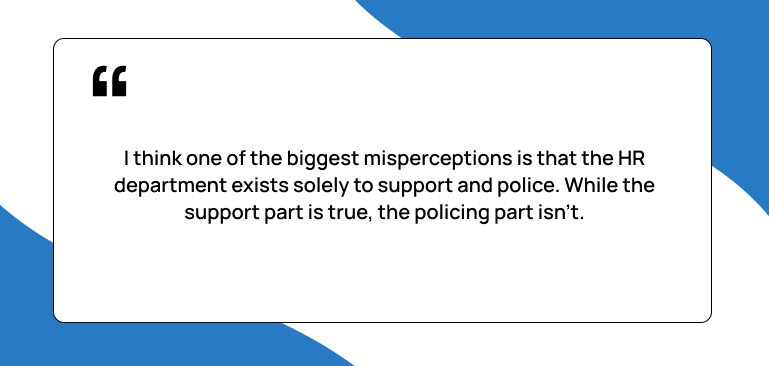
I think one of the biggest misperceptions is that the HR department exists solely to support and police. While the support part is true, the policing part isn’t.
We are not here to police people. Instead, we ensure that the guardrails necessary for operating the business are in place. Perhaps a better term is ‘monitor and enhance’. We aim to encourage and guide while upholding ethical and legal standards that no one should cross.
Think of it this way—our role is about prevention and guidance, not about stepping in only after something has gone wrong. If you wait to act only when there is a problem, then the damage is already done. Our focus is on taking preventative measures, advising, consulting, and leading people in the right direction.
A simple example is fostering respect among employees. Treating colleagues with respect should be straightforward, but sometimes people need those guardrails to help them align with the organisation’s values. That is what HR truly stands for—creating an environment where everyone can do the right thing and thrive together.
Luan Lam is a visionary Talent Leader with a proven track record in delivering complex, high-value rapid growth recruiting solutions that can be a competitive differentiator to compete for talent. He is highly effective in building distributed world-class teams and well-defined processes to keep up with exponential growth. He is strong in building solutions from scratch to drive top-line talent growth for the company to create the next great software company. Excellent in hiring, motivating, and retaining a team of top-notch talent acquisition warriors to create a powerful and seamless recruiting engine. Luan holds a degree in International Relations from the University of California, Davis.