

In an exclusive chat with All Things Talent, we interacted with Ms Harpreet Sandhu, the Chief Human Resources Officer at IMGC. Ms Sandhu shares IMGC's trailblazing journey in India's mortgage guarantee sector, and how the company champions diversity and talent development while leveraging AI. She also spills the beans on their robust employer branding strategy ensuring sustained growth and prominence in the industry. Dive in to discover how IMGC stays ahead of the curve.
Q) It has been a decade since you’ve been a part of IMGC, can you talk about your organisation a bit and how has the journey been?
Yes, it has been a decade since I joined IMGC. IMGC stands for India Mortgage Guarantee Corporation, and we are the first mortgage guarantee company in India. Our product, Mortgage Guarantee is well-established in markets like the US and Canada, but it is new to India. We have strong backing from organisations like Enact MI (leading US mortgage insurer), National Housing Board (NHB), Asian Development Bank (ADB), IFC (World Bank Group) and now Sagen (leading Canadian insurer), which has helped us establish ourselves in the market.
Born out of a vision for facilitating early home ownership and making housing affordable, our primary objective is risk mitigation for lending institutions by providing a backstop against credit defaults. Essentially, our product benefits both the lender and the homeowner, as it enables lenders to extend credit to diverse segments within the ecosystem, including underserved populations and the young demographic.
Currently, around 70% of our portfolio caters to the affordable housing segment, demonstrating our commitment to serving a diverse range of customers. However, we also collaborate with major lending institutions, including public and private banks and housing finance companies, working across various loan categories.
When we started, the concept of mortgage guarantee was relatively new in India, so we had to invest heavily in education and market awareness. Building a talented team was crucial, and over the years, we have attracted some exceptional talent who have contributed to our growth and success. we have developed a blueprint for what makes a good mortgage guarantee professional, which has been instrumental in shaping our team.
Overall, it's been an incredibly exciting and enriching journey for me personally, being part of the initial stages of IMGC's development. With around ₹26,000 crore of loans under our belt, we believe we're poised for even greater success in the future.
Q) What changes have you observed within this period?
The journey over the past decade at IMGC has been quite transformative. The initial few years were very much a building phase, where we were experimenting with various strategies to determine what would be effective and what would not—this period involved a lot of trial and error. However, in the last 3-4 years, we have transitioned from this build stage to a growth stage. We have now established a solid foundation, and our organisation is ready to expand significantly. In fact, on a year-on-year basis, we have been experiencing growth rates of 30-50%, and sometimes even higher. From a leadership perspective, our focus has shifted from building the platform to actively driving growth within the market. We are now aggressively pursuing market expansion.
Q) What specific challenges does the BFSI (Banking, Financial Services and Insurance) sector face in terms of talent acquisition and retention?
The BFSI sector has faced distinct challenges in talent acquisition and retention, particularly over the last 3-4 years, encompassing the pre-COVID and post-COVID periods. The job market has seen substantial opportunities, with reports from sources like the Economic Times indicating a 15-20% year-on-year growth. Despite this, a key challenge persists in aligning the available talent with the specific needs of organisations.
Many organisations are focusing on developing talent internally, providing learning opportunities to ensure employees become 'market ready'. For instance, at IMGC, a deep understanding of the mortgage market, B2B selling and stakeholder management are crucial skills that are not always readily available in the job market. Therefore, upskilling, development and training remain significant challenges across the BFSI sector. There are always niche areas, such as analytics and risk management, where demand exceeds supply. While the sector is in a good space overall, the ongoing struggle to have fully developed and trained talent continues to be a major concern.
Q) You spoke on the challenge of matching available talent with the specific needs of organisations. How does IMGC mitigate these challenges?
At IMGC, we take a proactive approach to training and developing talent within our organisation. For instance, when new employees join, we have a dedicated programme called New Hire Orientation (NHO) where our senior leadership team is highly involved. Our MD and CEO himself conducts the opening session to convey our vision and interact with new joiners. We also conduct B2B training sessions every two months, ensuring consistent learning opportunities.
On an annual basis, we conduct a Training Need Analysis to identify gaps and develop a comprehensive training calendar. This includes programmes covering product knowledge, processes, soft skills and more. We offer both classroom and online training modules to cater to diverse learning preferences.
Additionally, we organise specialised programmes like the leadership development program and executive development programmes. We have even collaborated with organisations like Virtuoskill to offer industry-specific certifications, such as the Certified Mortgage Professional (CMP) program.
Employees also have the freedom to nominate themselves for specific technical programmes or external learning opportunities through our Learning Assistant Program (LAP) where if an employees want to do some kind of learning over a period of 6 months to 1 year, the organisation will support them financially.
Overall, our goal is to provide employees with a holistic learning and development experience, equipping them with the skills and knowledge needed to excel in their roles.

Q) Let us talk about employer branding. How does IMGC strategically approach building and maintaining its employer brand in today's competitive market?
When it comes to employer branding, IMGC takes a targeted approach based on the specific segments we aim to attract or retain within the BFSI space. Our current employees play a crucial role as ambassadors of our brand. We recently received a high Pulse score, indicating positive employee sentiment and serving as a testament to our organisational values. Additionally, we actively practice an open-door policy, fostering transparent communication and trust, as reflected in our consistent Pulse scores.
In terms of new initiatives, we focus on capability building and ensuring our presence in relevant industry spaces. For instance, we organise an annual event called the India Mortgage Leadership Conclave (IMLC) in partnership with mortgage leaders. This summit has been an industry-only event for mortgages and positions IMGC as a thought leader. Through initiatives like IMLC, we strive to strengthen our presence and credibility in the mortgage space in India.
Q) In what ways does AI technology enhance your employer branding efforts?
Our organisation places a significant emphasis on leveraging technology to enhance various aspects of our operations, including HR management and business processes. While AI is an integral part of this technological journey, our focus extends beyond AI alone.
From an HR perspective, we utilise HR management systems to streamline the employee lifecycle, ensuring seamless experiences from onboarding to offboarding, including learning opportunities and annual appraisals. Moreover, we are actively exploring how technology can revolutionise our hiring processes to identify and onboard the right talent efficiently.
On the business side, automation plays a pivotal role in improving efficiency and productivity. For instance, we have implemented automation tools that have significantly increased the workload capacity of our underwriters, from processing four files to handling ten files within the same timeframe. This achievement is attributed to the implementation of a business rule engine and continuous process improvements, ingrained in our organisational DNA.
Our focus on technology is essential to adapt to the dynamic market landscape and diverse client base. Whether it's collaborating with traditional institutions or modern organisations with digital workflows, we ensure our systems can seamlessly integrate and respond to diverse requirements. For instance, we have introduced bots to automate data entry tasks, enabling underwriters to focus on core activities and expedite file processing.
Overall, our commitment to embracing technology across both business and HR domains underscores our dedication to staying agile, efficient and aligned with market trends, ultimately enhancing our employer branding efforts.
Q) Can you share examples of successful employer branding campaigns or initiatives that IMGC has implemented?
One of our successful employer branding campaigns from last year was called ‘Idea Box’. This initiative aimed to foster employee participation and innovation by inviting all employees to share ideas on improving organisational processes. We received around 40 ideas, which were then evaluated by various leaders. Two winning ideas were selected and senior leaders mentored the employees who proposed them. Over the next six months, these ideas were implemented in the business. This initiative was showcased at the FICCI HR Innovation Summit, where we were honoured with the FICCI HR Innovation Award, alongside prominent brands like L&T and ONGC.
Another initiative we are proud of is our focus on cross-functional movement within the organisation. Given our size, we emphasise providing employees with opportunities to transition between different functions. For instance, we have had employees move from underwriting to business development and from sales to other functions. This flexibility not only enhances employee satisfaction and growth but also strengthens our employer brand by highlighting our commitment to career development and internal mobility. These initiatives help us attract and retain talent by demonstrating our innovative and employee-centric approach.
Q) How does your company differentiate itself from competitors in the BFSI sector to attract top talent?
At IMGC, we differentiate ourselves by offering extensive learning opportunities and a breadth of experience that is uncommon in the BFSI sector. Employees in our organisation, especially those in frontline underwriting roles, engage with multiple lender partners, allowing them to gain a wide range of knowledge and experience. This extensive exposure is something that many of our employees, even during exit interviews, cite as a significant advantage of working with us.
Our commitment to continuous learning and development is a key differentiator. We offer robust training programmes, encourage cross-functional movements, and provide a dynamic work environment where employees can grow rapidly. For example, underwriting professionals from our team often advance to product manager or risk management roles in other organisations, demonstrating the high calibre of training and experience they receive at IMGC.
Additionally, we offer competitive perks and benefits. Our comprehensive medical insurance policy covers up to ₹10,00,000, including not just the employee's immediate family but also their parents. Our employees frequently highlight this policy as a valuable benefit.
Overall, our focus on learning, career development and competitive benefits has been a great stickler for us as we have gone through our employee journey and helps us attract and retain top talent in the BFSI sector.
Q) How does IMGC ensure diversity and inclusion in its workforce, especially in leadership roles? Please talk in detail about any of your programs for under-represented communities, if any.
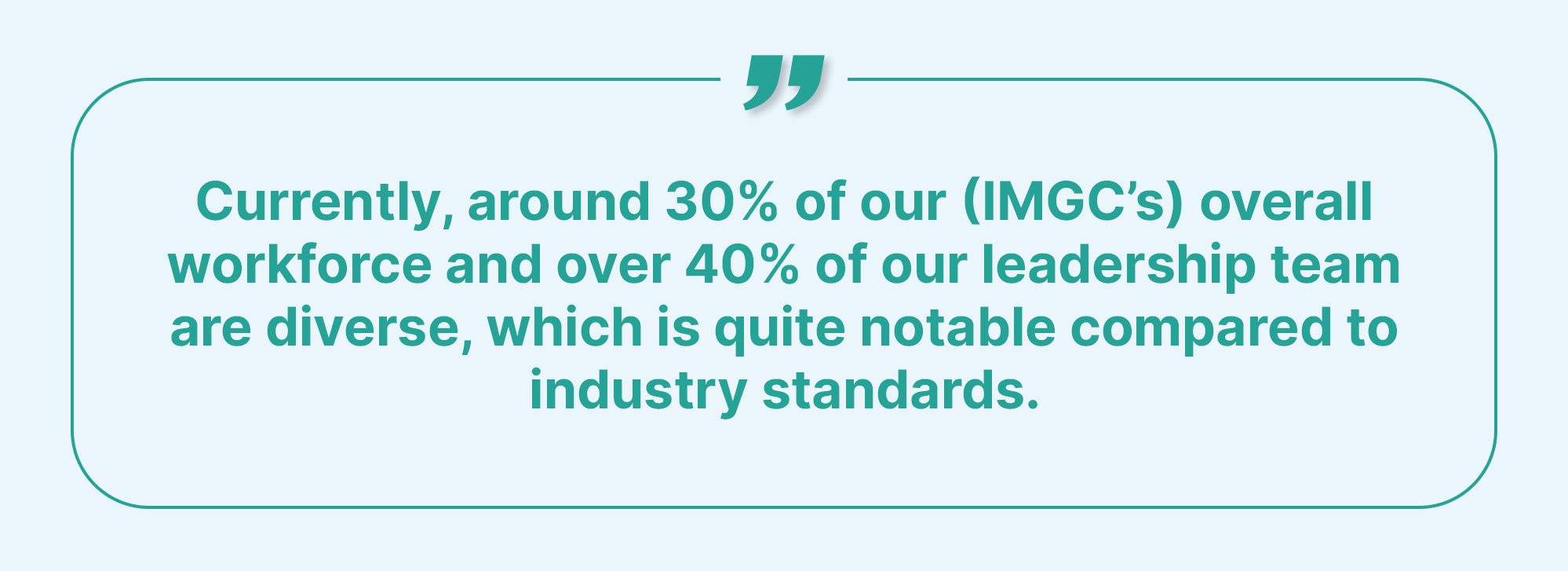
At IMGC, we prioritise diversity and inclusion across our workforce, including leadership roles. Currently, around 30% of our overall workforce and over 40% of our leadership team are diverse, which is quite notable compared to industry standards.
While we don't have specific programs exclusively aimed at managing diversity, our approach focuses on hiring talent from a wide range of backgrounds. To us, diversity extends beyond gender; it includes various professional experiences and perspectives. From the start, we have intentionally hired diverse sectors, such as insurance and rating agencies, to build a robust and varied team.
This strategy has helped us maintain a strong diversity profile, particularly in our underwriting team. However, we recognise that there is room for improvement in areas like sales, where diversity traditionally tends to be lower in our industry. We are committed to aligning with market trends and continuously enhancing our diversity efforts.
Q) How does the company encourage continuous learning and development to ensure employees remain relevant in an ever-evolving industry landscape?
At our company, we have various initiatives in place to foster continuous learning and development among employees. For instance, we offer structured training programs as well as opportunities for self-learning through initiatives like the Learning Assistant Program (LAP), where employees can enrol in external courses to enhance their skills.
Additionally, we organise informal interactive sessions called Confab sessions, where employees lead discussions on a wide range of topics, from cryptocurrency to bonsai plantation. These sessions provide a platform for knowledge-sharing and encourage the exploration of diverse interests within the team.
We also actively encourage employees to attend external conferences and events related to our industry, such as securitisation forums. Given the niche nature of our industry, we believe it is crucial to expose our team to various learning opportunities, both internal and external.
Furthermore, when employees attend external programs or conferences, they are encouraged to share their learnings and insights with the rest of the team during our regular catch-up sessions. This knowledge-sharing culture ensures that everyone benefits from the collective learning experiences of the team.
Our approach to continuous learning and development is both structured and self-directed, aimed at keeping our employees abreast of industry trends and equipping them with the skills needed to thrive in our ever-evolving industry landscape.
Q) What’s an HR principle that you abide by?
One HR principle that I strongly believe in is the idea that HR professionals should always align their efforts with the business objectives and contribute directly to the growth and success of the organisation. This principle was reinforced by a valuable insight shared with me by a senior leader, who emphasised the importance of transitioning from being solely an HR professional to also being a business leader who understands and speaks the language of HR. This shift in perspective underscores the notion that HR exists to serve the business and drive its progress forward. As HR professionals, our focus should always be on how our actions and initiatives directly impact the business and contribute to its overall success.
Q) Looking ahead, what future trends or developments do you anticipate will shape talent acquisition?
I foresee two significant trends shaping talent acquisition in the coming years. Firstly, there's a growing emphasis on HR professionals being integral partners in driving the business agenda. This means having a seat at the table and actively contributing to the day-to-day business decisions. Secondly, the landscape of talent acquisition is evolving rapidly, presenting both challenges and opportunities. For instance, recent changes like HDFC reducing its notice period (90 days to 30 days) reflect the dynamic nature of the industry. As we move forward, harnessing emerging technologies, particularly AI, will be crucial. While AI has already made inroads in the hiring process, there is still much to explore in other HR functions. Therefore, HR professionals must continuously adapt and innovate to leverage technology effectively and enhance talent acquisition strategies.
Harpreet Sandhu is the Chief Human Resource Officer (CHRO) at India Mortgage Guarantee Corporation. With over 17 years of experience, she leads HR strategy, communication and culture development to support the company's vision and business goals. Her background spans HR business partnering, talent acquisition and change management in the financial services industry.